Lords of the Valleys
The Tày of Sapa
Monumental stilt houses, UNESCO-listed Then singing, and millenary rice cultivation — the oldest people of North Vietnam's valleys.
Monumental stilt houses, UNESCO-listed Then singing, and millenary rice cultivation — the oldest people of North Vietnam's valleys.
Less visible than the Hmong in the streets of Sapa, less mysterious than the Dao in their rituals, the Tày are nonetheless one of the most fascinating and important ethnic groups in northern Vietnam.
As the first occupants of the valleys and high-altitude plains, builders of monumental stilt houses, and poets and musicians of a millenary oral tradition, the Tày form a people of cultural richness often underestimated by tourism that favors more spectacular costumes from their mountain neighbors.
The Tày are the second largest ethnic group in Vietnam after the Kinh. Their origins date back to Proto-Thai populations inhabiting Southern China and Northern Vietnam as early as the first millennium BCE. Unlike the Hmong and Dao, who arrived later in successive migrations, the Tày are considered one of the indigenous peoples of Northern Vietnam — present in the region for over two thousand years.
This longevity allowed them to develop an elaborate agricultural civilization, based on irrigated rice cultivation in valley floors. By the first millennium, the Tày mastered construction techniques for complex irrigation systems — canals, bamboo dams, wooden aqueducts — enabling the cultivation of terraced rice fields and alluvial plains with productivity far superior to high-altitude groups.
During centuries of Chinese domination and then in medieval Vietnamese kingdoms, the Tày often occupied positions as political and commercial intermediaries. Tày clan chiefs governed mường (semi-autonomous territories) recognized by Vietnamese sovereigns. This interface position between the plains and highlands forged a particular Tày identity — distinct from Kinh culture yet deeply influenced by it.
In Sapa, the Tày primarily settled in valley bottoms, notably in Bản Hồ, Nam Sài, and Nam Cang — relative lowland villages by rivers, in the most fertile areas of the region.
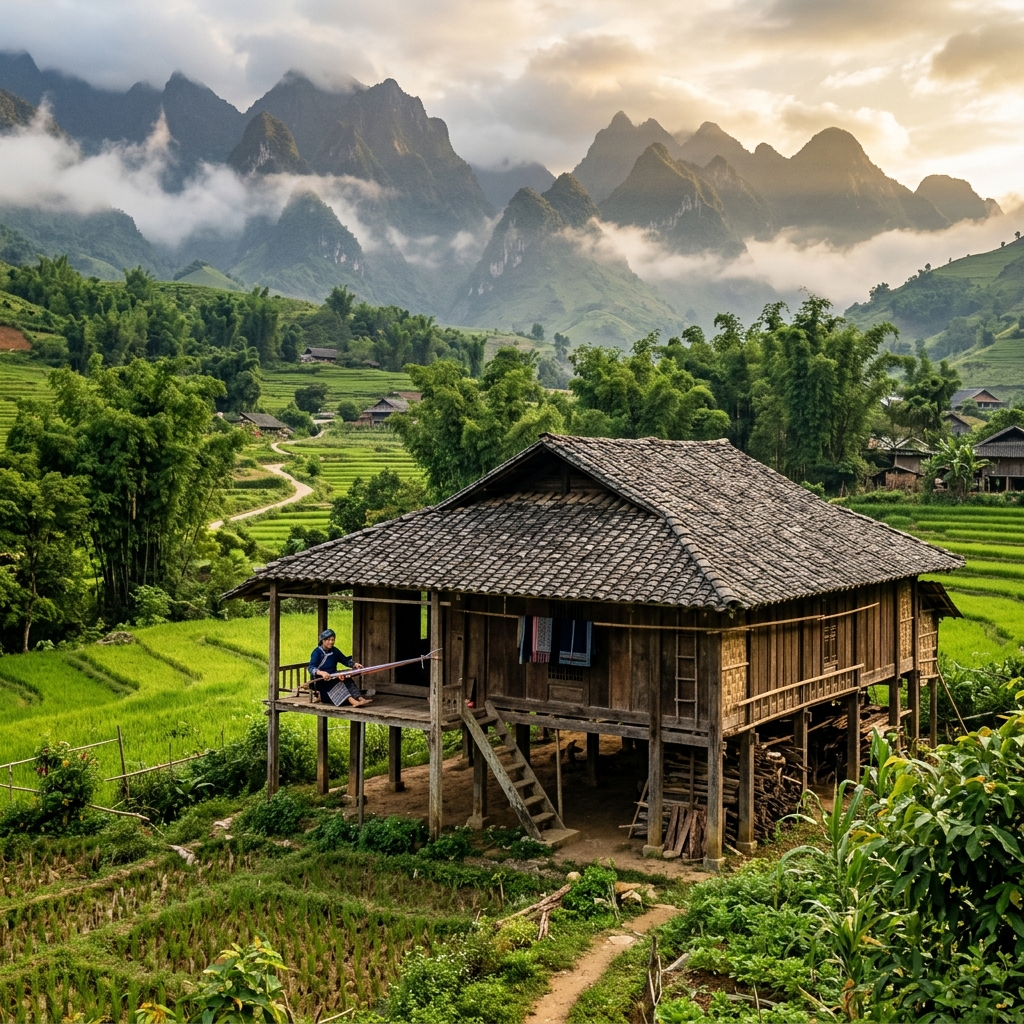
If one element were to symbolize Tày culture, it would be the nhà sàn — stilt house. These large dark wood buildings, perched on 2 to 3-meter pillars, are more than just a home: they are the architectural expression of a worldview.
The traditional Tày house is built entirely from forest wood — oak, chestnut, or bamboo — without nails or screws, using only mortise and tenon joinery. The framework, capable of supporting a gray tile roof weighing several tons, is a feat of traditional engineering. The largest houses can reach twenty meters in length and accommodate several families.
The space between the stilts and the raised floor is not wasted. Animals are sheltered there at night, agricultural tools and firewood are stored, and people work in the shade during the heat. This level creates a symbolic separation between earth (domain of animals and labor) and the floor (domain of humans).
The main room, accessible by an external staircase, houses the ancestral altar and the guest reception area. The kitchen, often at one end, features a permanent hearth whose smoke rises to the roof, naturally smoking meat and structural wood — an ancestral preservation technique that gives Tày houses their characteristic smoked wood scent.
Oriented toward the river or the rising sun, the veranda is the social heart of the Tày house. It's where people weave, braid baskets, receive neighbors, and watch the seasons pass. It symbolizes the Tày family's openness to the community and nature.
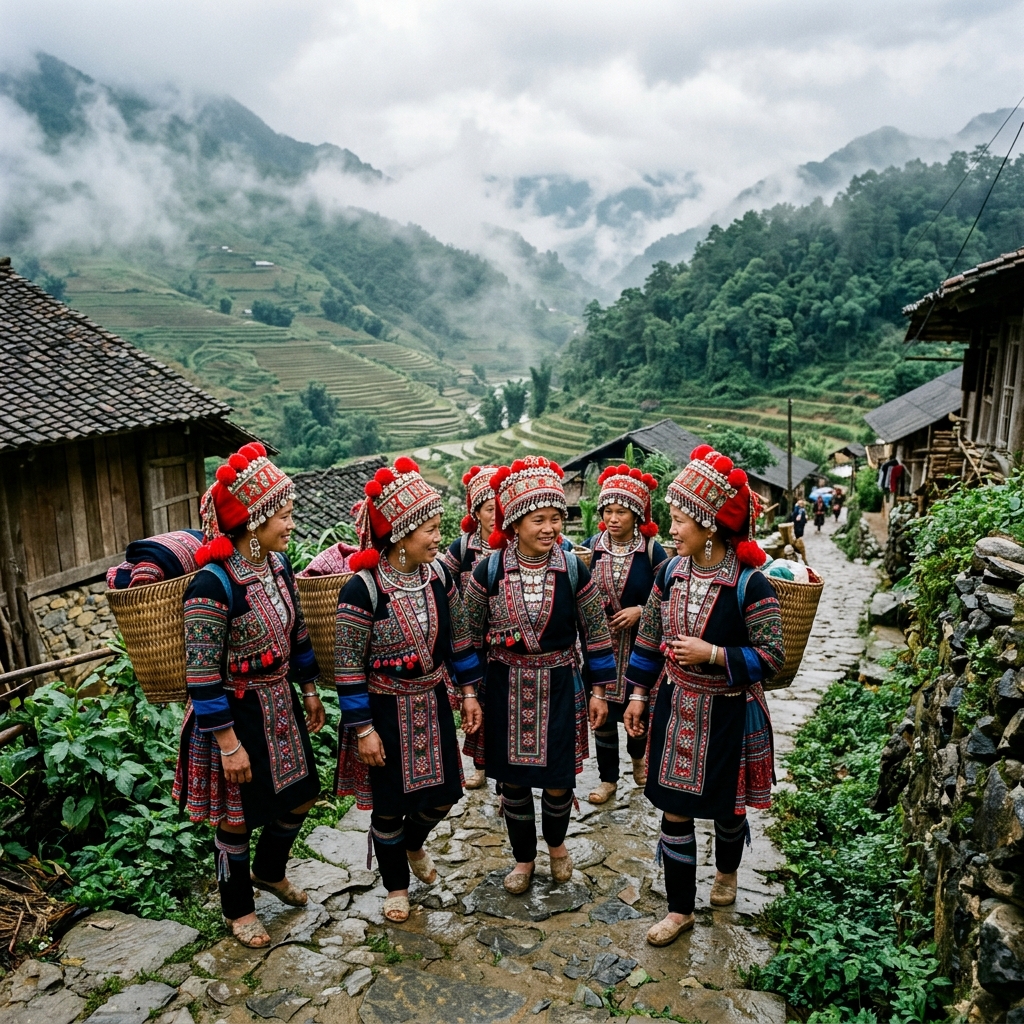
Compared to the color explosions of the Flower Hmong or the scarlet headdresses of the Red Dao, the Tày costume may seem understated. It is precisely this simplicity that makes it elegant.
The traditional female attire consists of a long tunic (áo dài tày) with a high collar, buttoned on the right side, in dark indigo, midnight blue, or black tones. A woven fabric belt — often red or burgundy — marks the waist.
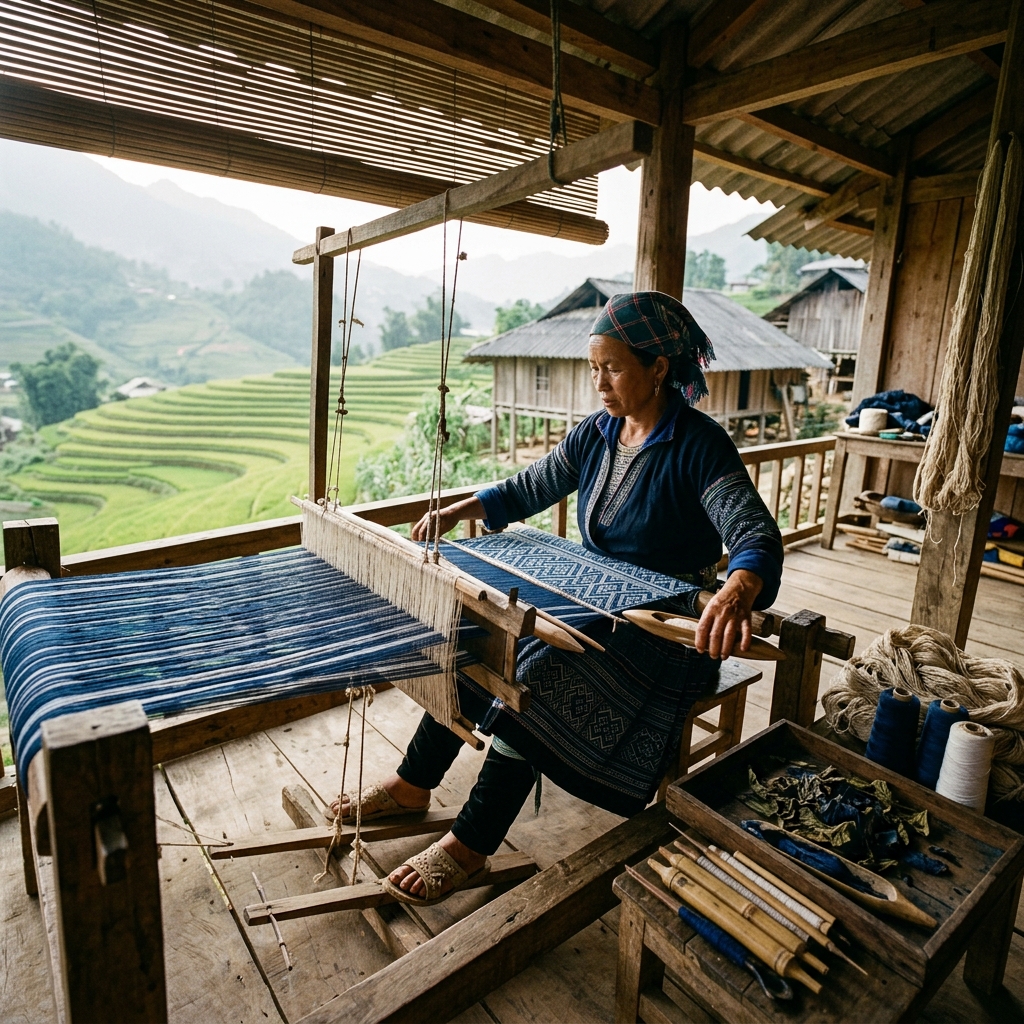
Hand-loom weaving (khung cửi) is the heart of Tày craftsmanship. Patterns are integrated directly into the fabric structure through a manual jacquard technique, without added embroidery: it is the calculated crossing of warp and weft threads that creates the design — in diamonds, checkers, or geometric meanders.
The Tày weaver simultaneously operates the heddle pedals (which lift certain warp threads) and the shuttle (which passes the weft thread) — creating a geometric design thread by thread, row by row, with extraordinary mechanical precision.
No drawn model, no pattern laid on the fabric. Only mental calculation and pattern memory.
The central spiritual figure of Tày culture is the Then — a shaman-priestess who serves as an intermediary between the world of the living and that of the spirits. Unlike the Hmong shaman (always a man), the Then is traditionally a woman, chosen by the spirits after a vocation experienced as a spiritual crisis.
Accompanied by the đàn tính (a two or three-stringed luth with a soft, melancholic sound) and chuông (ritual bells), the Then sings long poetic epics recounting the soul's journey in the spirit realms. Then singing (hát Then) has been listed as UNESCO Intangible Cultural Heritage since 2019.
The most important collective celebration in the Tày calendar after the New Year. It brings the whole community together for prayers to the earth and water spirits, offerings for a good harvest, and a day of traditional games — wrestling, archery, cane ball games. The Lồng Tồng of Bản Hồ is one of the most beautiful in the Sapa region.
Tày society is patrilineal, organized around the clan (họ) sharing a common name and mutual ritual obligations. Common Tày clan names include Hoàng, Nông, Lục, Ma, Lương — names that sometimes betray distant Chinese origins or ancient administrative sinicization.
Placed on the main wall of the house facing the entrance, the altar receives daily offerings and presides over all important decisions. Tày funerals are elaborate multi-day ceremonies blending singing, music, banquets, and rituals guiding the soul to the ancestral world.
Always ask permission before photographing an altar in a Tày house — it is a sacred space.
The Tày are often described as the most well-integrated ethnic minority in modern Vietnamese society — which is both their strength and their cultural fragility. Geographic and economic proximity to the Kinh, a tradition of literacy, and participation in administrative structures have created a cultural permeability that facilitated Tày social mobility but also accelerated the assimilation of certain cultural elements.
Around Sapa, the Tày villages of Bản Hồ and Nam Sài have been less transformed by mass tourism than Hmong villages closer to the center. This relative preservation is due to geographical distance — Bản Hồ is 25 km from Sapa on a winding road — and a local economy less dependent on direct artisanal tourism.
The number of Then capable of conducting complete ceremonies decreases each decade. Cultural associations and university programs are working to document and transmit this repertoire, with mixed results — Then transmission is above all a spiritual vocation, not a technical skill that can be taught in a classroom.
Tày cuisine, on the other hand, is seeing remarkable renewed interest. Specialities are appearing on Sapa restaurant menus and gaining gastronomic recognition that directly benefits valley producers:
The Tày are the second largest ethnic group in Vietnam with about 1.9 million people according to the 2019 census, concentrated in northern mountainous provinces — Lào Cai, Hà Giang, Cao Bằng, Lạng Sơn, Bắc Kạn. It is the most numerous minority group in the country.
Tày and Nùng are two very close groups, sharing an almost identical language, similar cultural practices, and often the same territories. The distinction is historically linked to geographical origin — the Nùng supposedly arrived later from China — and some costume and ritual differences. In daily life, the two groups often mix and intermarriage is frequent.
Yes, it's one of the most authentic experiences in the region. Several Tày families in Bản Hồ offer homestays in their traditional houses. Conditions are simple — mattresses on the wood floor, external toilets, shared meals with the family — but the welcome is warm and the setting exceptional. Best booked through a Sapa agency.
Private Then ceremonies — for illness, marriage, or funerals — are in principle not open to foreigners. Some cultural festivals organized in Lào Cai or Tày provinces include public Then singing demonstrations. This is the most accessible way to hear this exceptional music without intruding into a private ritual context.
Tày cuisine is generous mountain fare, based on mountain black pork, free-range chicken, sticky rice, and wild herbs. Smoked pork (thịt lợn cắp nách) — dried and smoked for several weeks over the hearth — is the most iconic speciality. Bamboo-steamed sticky rice (khẩu lam) and black bean rice cakes (bánh khảo) are must-tries. Simple, deep, and memorable cuisine.
We organize excursions and overnight stays with Tày families in the Bản Hồ valley, combinable with a trek through rice paddies and an evening around the traditional hearth — as part of our custom tours.