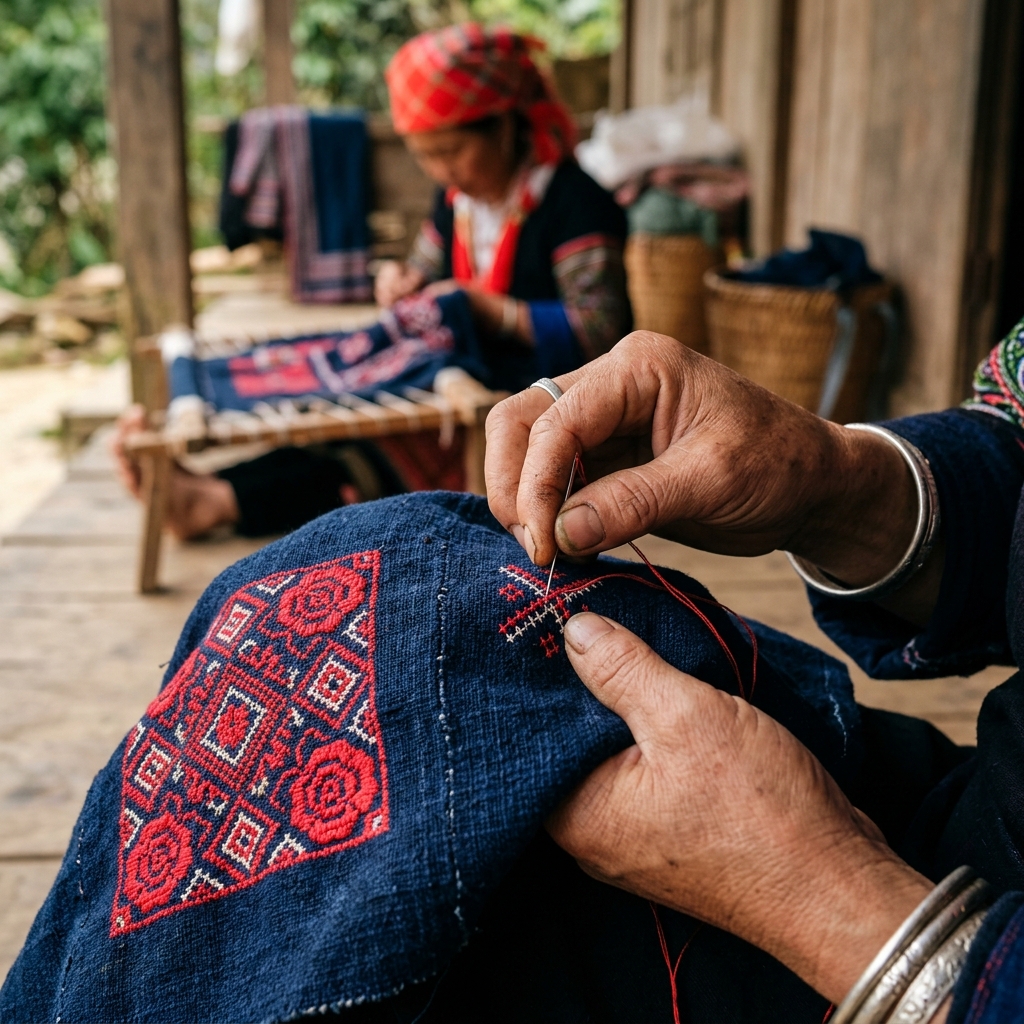
Hand of a Red Dao woman embroidering a reverse cross-stitch pattern on indigo fabric in Sapa
HomeCultureCrafts › Embroidery
Ancestral Expertise

Embroidery in Sapa

The soul of minority textiles — Hmong chain stitch, Red Dao reverse cross-stitch worked blindly without patterns, and the sober geometry of the Xa Pho. A language of threads that few travelers can decipher.
If weaving is the skeleton of Sapa's minority textiles, embroidery is its soul. It transforms a simple piece of fabric into a narrative, an identity, and a work of art.

Every stitch placed by a Hmong, Dao, or Xa Pho woman is not a trivial gesture — it is the repetition of a learned childhood skill, the reproduction of a meaningful motif, and the continuation of a tradition spanning centuries. In Sapa, embroidery is everywhere: on women's clothing in the streets, at market stalls, and between the fingers of artisans sitting before their homes. Learning how to truly look at it radically changes your experience in the region.

Embroidery as Visual Language

In all ethnic cultures of the region, embroidery serves a function far beyond decoration. It is a visual communication system — a coded language that community members can read and that foreigners can only admire without deciphering.

Elder women can read these codes from a distance — they can identify a stranger's origin and social status just by observing her embroideries. This semantic dimension makes each embroidered piece unique: unlike industrial fabric reproducible endlessly, a hand-embroidered piece is a singular object bearing the invisible signature of the hand that created it.

🛡️

Clan Belonging

Embroidered patterns indicate the origin clan — readable by any community member.

💍

Marital Status

Specific motifs appear on wedding costumes, others on garments for married women.

🧿

Spiritual Protection

Certain motifs are sewn onto children's clothes to ward off evil spirits.

🏔️

Region of Origin

Local pattern variations help identify an artisan's village or valley.

Embroidery Techniques by Ethnic Group

Each group has developed its own techniques, patterns, and aesthetics. These differences are not superficial — they reflect profoundly distinct worldviews.

Black Hmong of Sapa

Chain Stitch & Embroidered Batik

  • Chain Stitch
  • Satin Stitch
  • Cross Stitch

Black Hmong embroidery typically combines several techniques on one piece. The chain stitch — a series of looped stitches forming a continuous line — traces pattern contours. Satin stitch covers interior surfaces with tightly placed threads.

Motifs and Meanings:
  • The spiral → sun or snail depending on context
  • The meander → rivers and mountain paths
  • The double triangle → union of living and ancestors

Colors: red, yellow, green, white on dark indigo background.

Flower Hmong — Bac Ha Region

Chromatic Explosion — Full Surface

  • Full Surface Embroidery
  • Metallic Threads
  • Total Coverage

The background fabric almost entirely disappears under a dense layer of multicolored threads — reds, greens, yellows, blues, oranges — arranged in bands that cross in motifs of staggering complexity. Threads are laid parallel to fully cover the surface, creating a tapestry effect.

Metallic Thread Specialty: On some prestige pieces, silver or gold threads are woven between silk threads to add light reflections. The result is a fabric so dense it becomes rigid — an architectural piece as much as a textile one.
Red Dao — Tả Phìn

Reverse Cross-Stitch — Worked Blind

  • Work from Reverse
  • No Drawn Pattern
  • Pure Memory

Red Dao embroidery is the most technically demanding in the region — probably one of the most sophisticated in Southeast Asia. Its absolute uniqueness: embroidering on the reverse side of the fabric, without a pre-drawn design, solely from memory. The embroiderer only sees the final result upon turning the work over.

Mathematical Feat: Cross-stitches are placed by counting warp and weft threads. The slightest error in counting produces an immediately visible shift on the front. Patterns — stylized animals, geometricized flowers, star figures — are memorized as verbally transmitted counting sequences.

Colors: red, white, and black dominate, with yellow and blue accents.

Xa Pho — Isolated Hamlets

The Geometry of Discretion

  • Cross Stitch
  • Stem Stitch
  • Aesthetics of Space

Xa Pho embroidery is the least known in the region — and the most singular in its relationship with space. Geometric motifs — broken lines, zigzags, concentric diamonds — are worked only on specific areas: collar, cuffs, trouser bottoms, borders.

Aesthetics of Empty Space: Patterns do not try to cover the entire available surface. Areas of bare, unembroidered fabric are an integral part of the composition — an aesthetic of restraint evoking East Asian calligraphic principles.

Palette: white, red, and black on indigo background — sober and precise.

Learning: A Lifelong Education

In all regional embroidery cultures, learning starts very early — between five and eight years old — and never truly ends. A Hmong or Dao girl first observes her mother and grandmother working for months before ever touching a needle. Correction comes from observation, not verbal instruction — observe, repeat, perfect.

5–8 Years Old

Silent observation of mothers and grandmothers — months before touching a needle.

10–12 Years Old

A Dao girl masters basic motifs — and will continue enriching her repertoire throughout life.

Matrimonial Status

The quality of her embroidery is a real matrimonial advantage — a sign of discipline and respect for tradition.

Execution Speed

An experienced Dao embroiderer places several hundred cross-stitches per hour with staggering regularity.

Must-See Experience

Watching a Dao woman at her reverse cross-stitch — blind, patternless, counting threads with metronomic precision — is one of Sapa's most arresting experiences. It's almost intimidating as it reveals a level of mastery lost to modern cultures.

Where to See and Buy Authentic Embroidery

📍

Tả Phìn Village

The benchmark for Red Dao embroidery. Women work in groups before their homes, often available to explain their technique. Direct purchase from artisans ensures fair pricing and full traceability.

🏪

Sapa Market (Weekend)

Hmong embroiderers sell pieces directly here. Best pieces sell fast on Sunday mornings — arrive early, before 8:00 AM, to find the finest work.

🏮

Bac Ha Market (Sunday)

The best place for Flower Hmong embroidery — the region's most exuberant and colorful. An authentic ethnic market less transformed by tourism than Sapa's.

🤝

Sapa O'Chau & Indigo Cat

These cooperatives select authentic embroideries with producer traceability. Ideal for those who want to buy without haggling or risking industrial products.

🧵

Embroidery Initiation Workshops

Several Sapa structures offer half-day initiations to Hmong cross-stitch or chain stitch — enough to measure the difficulty and take home a personal souvenir.

How to Tell Hand from Machine Embroidery

A key question in Sapa markets, where industrial copies imitating traditional crafts are common.

🔍

The Reverse Reveals All: On hand embroidery, the back is organized but imperfect — loose threads between motifs are visible. Machine work has perfectly regular continuous threads.

Slight Irregularity is Proof: Hand embroidery has natural variation in stitch size and spacing. Paradoxically, perfect mechanical uniformity signals industrial production.

🤲

Touch Tells the Truth: Natural silk thread has a softness and reflection synthetic threads can't match. Rub gently — natural silk slides, synthetics snag slightly.

💰

Price is a Decisive Indicator: A piece sold for a few tens of thousands of dong cannot be authentic hand embroidery representing hours of labor. If the price feels too good to be true, it is.

Frequently Asked Questions about Sapa Embroidery

How long does it take to embroider a full garment?

It depends on the piece and technique. A small Dao pouch can take two to three days. A full Hmong jacket with embroidered cuffs and collar — one to two weeks. A full Dao costume including headdress, jacket, and trousers — several months, sometimes an entire year part-time between farm work.

Do embroidered patterns always have the same meaning between villages?

No, and that's the fascinating complexity. The same geometric motif can have different meanings by group, clan, or even family. Embroidery reading is local, non-universal knowledge.

Can I order custom embroidered pieces in Sapa?

Yes, through some artisans or cooperatives. Allow several weeks minimum for elaborate pieces — and accept the final pattern will be the artisan's, not an exact copy of a model. Authentic embroidery is not industrial commission.

Do men embroider in regional cultures?

No. Embroidery is exclusively a female practice in Sapa's ethnic groups. Men master other crafts — blacksmithing, carpentry, instrument making — but never traditional embroidery.

Is traditional embroidery threatened with disappearance?

Yes and no. Transmission remains strong in isolated villages. In touristy ones, it's partly industrialized. The threat is standardization and loss of meaning. Buying directly from village artisans is an act of cultural preservation.

Interested in a Dao or Hmong Embroidery Initiation?

We include artisan visits and embroidery workshops in our tours — in Tả Phìn with Dao women or Hmong villages in Muong Hoa valley. An hour with a Dao embroiderer permanently changes how you view these pieces.

Continue Exploration

← Back: Sapa Crafts
Weaving

Weaving

From hemp thread to ancient fabric.

See Guide
Indigo

Indigo

The secret of the mountains' deep blue.

See Guide
Silverwork

Silverwork

The shine of Tày and Red Dao jewelry.

See Guide