Blue Alchemy
Indigo Dyeing in Sapa
From green to deep blue-black in seconds — the magic of oxidation, 2,000 years of expertise, and living vats maintained for decades in Hmong villages of the Hoàng Liên Sơn.
From green to deep blue-black in seconds — the magic of oxidation, 2,000 years of expertise, and living vats maintained for decades in Hmong villages of the Hoàng Liên Sơn.
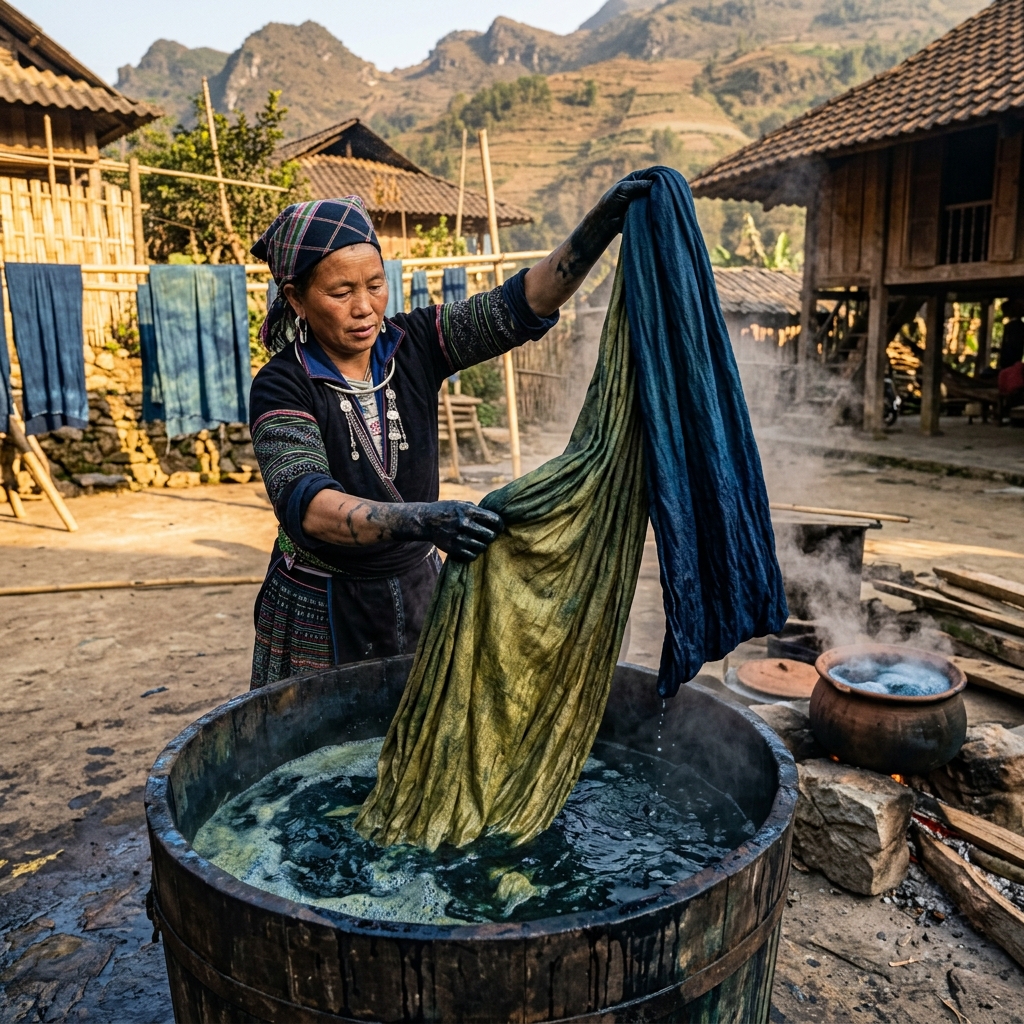
There is something almost magical about indigo dyeing. You dip a fabric into a vat of greenish liquid, pull it out — and before your eyes, in seconds of contact with air, the fabric transforms: from green to blue, from blue to deep blue-black.
This spectacular oxidation, repeated dozens of times to achieve the desired color, is at the heart of one of Sapa's oldest ethnic minority craft traditions. A tradition spanning millennia in Asia, it remains remarkably relevant today — both as living cultural heritage and an object of growing global interest in natural dyes.
Visible Transformation — From Bath to Open Air
Indigo is not a color — it is a molecule, indigotin, present in the leaves of several plants. In the Sapa region, the primary plant used is Polygonum tinctorium — an annual herb with oval leaves and reddish stems, grown in Hmong and Dao village gardens between 800 and 1,500 meters altitude.
This practice has been known in Asia for at least 2,000 years. Traces of indigo dyeing have been found on Chinese textiles from the Han Dynasty (206 BC). In Vietnam, it dates back to at least the 10th century in mountain regions — and modern blue jeans, dyed with synthetic indigo since the 19th century, are direct heirs.
What makes indigo remarkable: its exceptional fastness. Unlike most vegetable dyes that fade quickly, well-fixed indigo resists for decades — or even centuries under certain conditions.
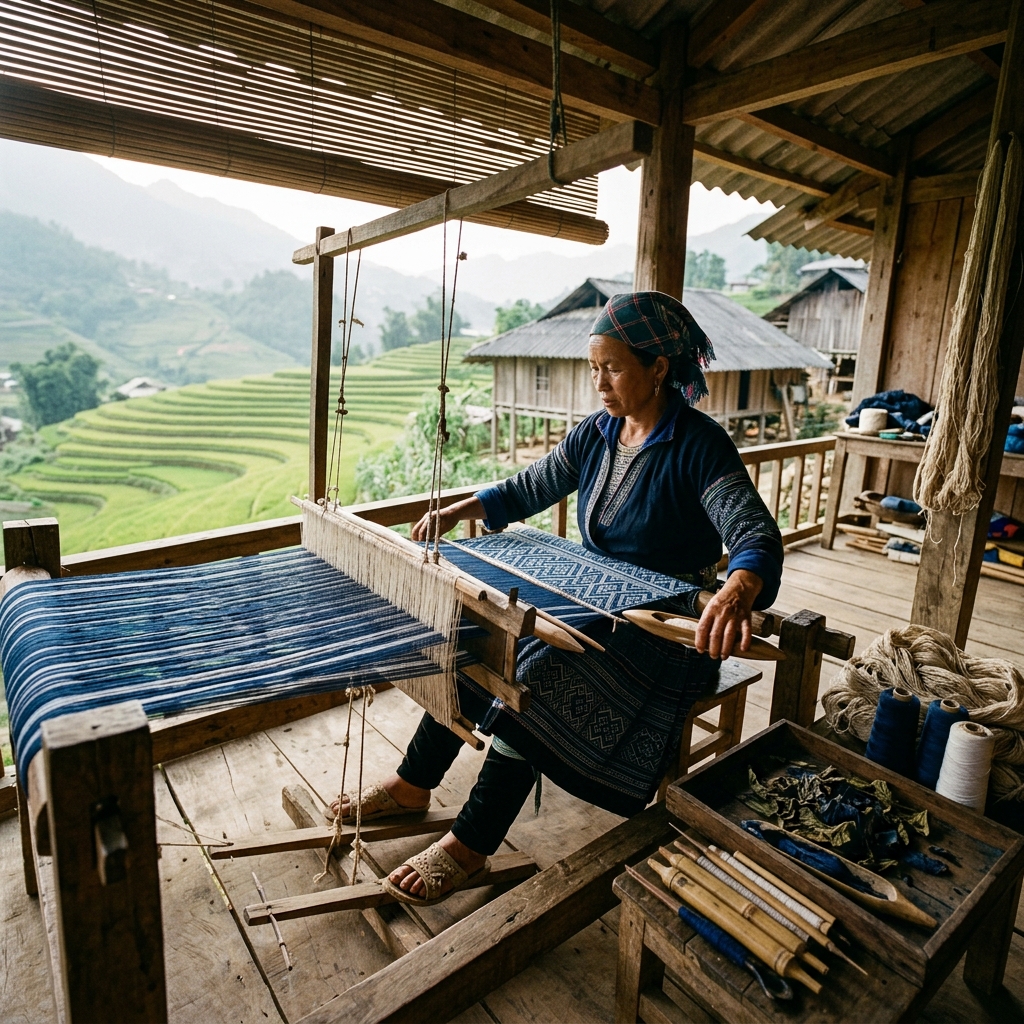
Preparing the indigo vat is the most complex step — a biological fermentation mastered empirically by artisans through generations of precision.
Fresh leaves are submerged in a large wood or ceramic vat with cold water. Bacteria break down cell walls, releasing indigotin precursors. The water turns from bright green to a characteristic green-yellow.
Spent leaves are removed and pressed. The resulting green-yellow liquid contains invisible indigo, as the molecule is in its reduced form (leuco-indigo), colorless and water-soluble.
Quicklime or wood ash is added to alkalinize the bath — essential for indigotin to fix onto textile fibers. The amount is determined by experience: too little won't fix; too much damages the fabric.
The vat is vigorously agitated with large wooden paddles to oxygenate. This oxidation transforms soluble leuco-indigo into insoluble indigotin, which precipitates as blue flakes. The bath turns from green-yellow to blue-green, then deep blue.
Water is drawn off and the precipitated indigotin flakes — indigo paste — are recovered, pressed into cakes, and stored away from air. This paste lasts months or years and is the raw material for all dyeing.
The dye vat — often a wooden trough, barrel, or ceramic pot — is the heart of the indigo workshop. It contains indigo paste redissolved in an alkaline, reducing environment. Ingredients include: indigo paste, alkali (lime or ash), reducing agent (fermented rice wine, rice bran, or fermented fruit juices), and water.
Experienced artisans recognize a ready vat by its smell (slightly alcoholic, earthy), its color (green-yellow surface, deep blue bottom), and the formation of a characteristic coppery foam on top.
A well-maintained vat can be used for weeks or months with regular refilling. Some Hmong artisans maintain active vats almost permanently during dyeing season.
Some vats are decades old — their unique bacterial flora contributes to incomparable dyeing results impossible to reproduce with new vats.
Fabric — Hmong hemp, cotton, or silk — is dipped for 10–30 minutes, then removed and exposed to air. Emerging as a dull green-yellow, it begins transforming within seconds — a pale blue that progressively deepens.
The first dip produces pale blue. For the deep blue-black characteristic of Hmong costumes, one must repeat the operation dozens of times — dipping, oxidizing, and fully drying between each bath.
Black Hmong perform up to 20–30 dips for ceremonial costumes
Each dot represents one dip + full drying. Color evolves from pale blue to deep blue-black over successive baths.
A Hmong blue-black dyed with 20–30 dips will take years to lighten with washing — and as it ages, it develops a slightly iridescent patina of particular beauty that synthetic dyes cannot reproduce. A living fabric that continues to evolve throughout its useful life.
Indigo dyeing among the Hmong is often paired with hot wax batik — a resist-dyeing technique creating patterns in reserve. Before dyeing, a Hmong woman applies melted beeswax with a brass stylus or fine brush, tracing precise geometric motifs.
The wax waterproofs applied areas, preventing dye penetration. After successive indigo baths, wax is removed in boiling water — revealing reserve patterns: white or pale blue on deep blue-black.
The precision of patterns achieved — hand-traced, patternless, on supple fabric reacting to wax heat — is one of the region's most demanding and beautiful artisanal techniques to observe.
Apply melted beeswax with brass stylus to areas to preserve
Normal Dyeing — 20–30 dips in indigo vat with air oxidation between
Wax Removal in boiling water — wax melts and floats away
Pattern Revelation — reserve patterns appear against deep blue
Most accessible place to observe dyeing in action. Several Hmong families maintain active vats and welcome visitors. Participatory workshops include fabric preparation, immersion, and oxidation observation — half-day.
Similar experience with the Dao, using slightly different techniques — notably fermented fruit juice reducing agents instead of rice wine, for a vat with unique character.
Sapa's benchmark, fully dedicated to indigo dyeing valuation. Workshops, authentic fabric sales, and awareness. Best address for pedagogical understanding and fully traceable purchases.
Also offers dyeing workshops in surrounding villages combined with artisan family visits. A good balance between learning and immersion in community daily life.
After decades of retreat before cheap synthetic dyes, natural indigo dyeing is seeing a remarkable resurgence in Sapa, driven by several converging dynamics.
Vietnamese and foreign fashion designers incorporate indigo-dyed Hmong fabrics, creating new outlets for mountain producers.
Growing valuation of natural dyes over synthetic ones — a competitive advantage Sapa's artisans now benefit from.
Vat preparation requires time, patience, and empirical knowledge only acquired through repeated practice.
Yes, absolutely. Workshops are accessible to all. A half-day is enough for main stages — fabric preparation, dipping, oxidation, rinsing, and drying. You take home a uniquely hand-dyed piece.
Yes, persistently. Artisans' hands are often permanently blue — a mark Hmong women wear with pride. For workshops, wear clothes you don't mind staining. Skin coloration fades in a few days.
Well-fixed indigo is remarkably fast — much more so than most natural dyes. However, like all natural colorants, it evolves over time — deep blues lighten to a patina many find more beautiful than the original color.
Indigotin is the same molecule. The difference is process: natural is extracted from plants through fermentation in a living vat; synthetic is industrial chemical production. Natural indigo-dyed fabrics age differently, with greater depth and unique patina.
Indigo Cat is the benchmark for traceable fabrics. Weekend markets are direct, but be vigilant. Authentic natural indigo shows slight irregularity in color depth — fold areas reveal lighter blue due to natural surface penetration.
We include indigo dyeing workshops in our cultural tours — in Cát Cát with Hmong families or Tả Phìn with Dao tradition. A half-day with hands in the vat — and a unique personal souvenir.