Metal & Memory
Ethnic Silverwork in Sapa
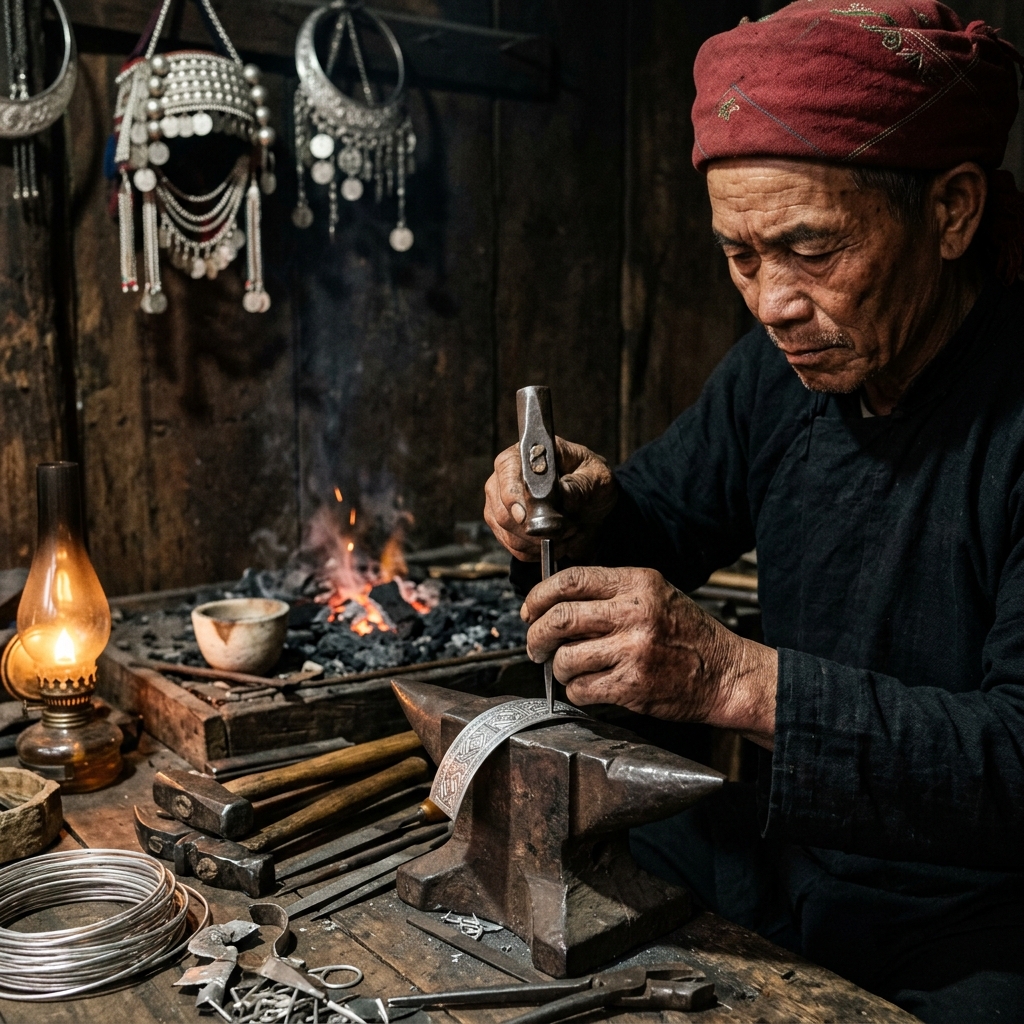
Casting at 961°C, cold hammering, burin engraving — in the dark workshops of Tả Phìn, Dao artisans perpetuate millenary gold and silversmithing. A heritage few travelers see born.
Casting at 961°C, cold hammering, burin engraving — in the dark workshops of Tả Phìn, Dao artisans perpetuate millenary gold and silversmithing. A heritage few travelers see born.
In Sapa's markets, around a corner or at a village entrance, your gaze inevitably catches silver jewelry. Multi-row necklaces of round coins, hammered bracelets with matte reflections, spiral earrings, rings engraved with geometric motifs.
The silverwork of North Vietnam's ethnic minorities is of powerful, sober beauty, far from industrial jewelry. It's also much more than ornament: family heritage, identity marker, spiritual protection, and fruit of expertise passed down through generations.
Silver coins sewn onto headdresses, necklaces worn from childhood, bracelets given at birth — all primarily function to ward off evil spirits and attract ancestral benevolence. A Dao child wearing silver from birth is protected.
Silverwork materializes family wealth and social status. A Hmong woman wearing heavy torque necklaces and multiple bracelets signals prosperity clearly. Jewelry can be melted and sold in urgent need — a portable store of value.
Marriage dowries almost always include silver jewelry — value and quality are negotiated between families. In some clans, wedding jewelry is passed from mother to daughter-in-law for generations.
The entirely manual process uses techniques modern industry has mechanized — but giving results with irregularity and life industrial jewelry cannot reproduce.
Raw silver is melted in a small clay crucible heated with a blowtorch. Fusion temperature is 961°C — heat regulated by the artisan's eye and experience. Today silver comes from purchased ingots; formerly, coins were collected and melted.
Molten silver is cast into an ingot, then cold-hammered on an anvil. Hammering shapes it and densifies the metal's crystalline structure, making it harder. Between sequences, metal must be annealed — heated red to release internal tension and restore malleability.
Hammered bars are transformed into silver wires of various sections, used for twists, spirals, and filigree. The artisan passes metal through a draw plate — pulling it through progressively smaller holes until reaching desired fineness.
Engraving is incised directly with burins. Repoussé works in relief — metal is placed on a soft support (pitch or fine sand) and struck from behind with punches to create surface relief. Both coexist on one piece.
Red Dao silverwork is typically polished to a slight matte, natural look. Some Hmong jewelry is polished bright with chamois soaked in fine ash — a simple, effective ancestral technique.
Dao aesthetics play on multiplication and fineness — dozens of small elements assembled for striking visual richness. Sewing coins onto clothes constitutions portable family wealth.
The Full Headdress — most spectacular work. Dozens of silver coins, red wool pompoms, and braided threads. Can weigh over one kilogram.
Row Necklaces — hammered silver beads (round, flat, flower-shaped) separated by spacers, finished with worked clasps.
Spiral Earrings — large spirals made of twisted silver wire, worn in ears pierced from childhood.
Hmong aesthetics are diametrically opposed — while Dao play on fineness, Hmong bet on mass and power. Metal quantity is as important as form.
The Torque Necklace — solid silver rigid ring passed around the neck. Sometimes over 500 grams. Strong identity marker.
Thick Bracelets — adorned with relief patterns (dragon heads, flowers, geometric bands). Worn in numbers as ornamental armor.
Decorative Hairpins — ends adorned with spheres, flowers, or small animals in spun silver.
In Sapa-area villages, silversmiths are few — usually one or two per village, sometimes none. This rarity signals both technical demand and transmission fragility.
Learning silver forge takes years. An apprentice starts with simplest tasks — minding fire, preparing metal, polishing — before progressing to hammering, drawing, engraving, and design. This slow progress is hard to maintain when youth are lured by faster economic opportunities in tourism or cities.
Several Red Dao artisans in Tả Phìn are still active. Their dark workshops, equipped with bellows, anvils, and collections of hammers look more medieval than modern. Witnessing their work is one of Sapa's most striking curious traveler experiences.
The absolute reference for Dao silver. Several artisans work in the village and sell directly. Buying on-site guarantees authenticity and ensures the full price reaches the producer.
Quality varies highly. Some stands are held by artisans — heavy jewelry, careful finish. Others sell cheap alloys — light, overly shiny, very low price. Distinguish carefully (see below).
Best for Flower Hmong silverwork — regional artisans show pieces not found in Sapa, like large headdresses and massive torques.
Selection of authentic silverwork with producer traceability. Slightly higher cost than the market, but guaranteed quality and direct community impact.
A crucial question in Sapa markets where cheap imitation alloys are omnipresent.
Weight: Silver is dense. Authentic pieces are markedly heavier than they look. A piece feeling light for its size is suspect.
Color: Authentic silver is slightly grayish with a natural matte luster. Alloys are often whiter and more shiny — too uniform.
Magnet Test: Silver is not magnetic. If a magnet attracts it, it contains iron and isn't silver. A simple, reliable test.
Irregularity: Hand-made jewelry shows surface variations — hammer marks, wire thickness changes — that industrial jewelry lacks.
Marking: Quality silver is marked 925 or 999. Few ethnic artisans mark pieces, but those via cooperatives do increasingly.
Tourist shops in the center charge 2-3x more.
It varies widely. Village artisans generally use high content silver — 925 or above. Tourist stand jewelry might be low alloy or just silver-plated. Rule: buy heavy, matte, and direct.
Yes, at Tả Phìn workshops or through Sapa shops. Allow several days to weeks. Artisans won't replicate Western jewelry perfectly but can adapt their tradition for you.
Yes for most — rings, bracelets, simple earrings. Hmong torques and Dao headdresses are ceremonial and too heavy for Western daily use. Rings and thin bracelets are perfect.
High content silver tarnishes naturally — this is normal oxidation. Occasional cleaning with a soft cloth restores luster. Avoid salt water and perfumes. Dao artisans use fine ash mixed with water.
We organize visits to Red Dao silversmith workshops in Tả Phìn — a rare experience, close to artisanal gesture, integrated into our custom tours. An hour in this workshop changes how you look at market jewelry.