Valley Floor People
The Giáy of Sapa
Beekeepers, basket weavers, and guardians of the Tả Van valley — the most discreet and resilient culture in the Sapa region.
Beekeepers, basket weavers, and guardians of the Tả Van valley — the most discreet and resilient culture in the Sapa region.
In the ethnic landscape of Sapa, the Giáy occupy a discreet yet essential place. Fewer in number than the Hmong or Tày, less known to tourist circuits than the Red Dao, they nonetheless form a community of remarkable cultural richness, with the Tả Van valley as its beating heart.
Beekeepers, farmers, weavers, and musicians, the Giáy are the people of the valley floors — those who tamed the region's most fertile lands and developed an agrarian civilization of such subtlety that the hurried traveler only catches a glimpse.
The Giáy — pronounced approximately "Zay" — belong to the large Thai people family, along with the Tày, Nùng, and Lào. Their origins trace back to Proto-Thai populations in Southern China's Yunnan and Guangxi provinces. Their migration to Northern Vietnam occurred progressively between the 13th and 18th centuries.
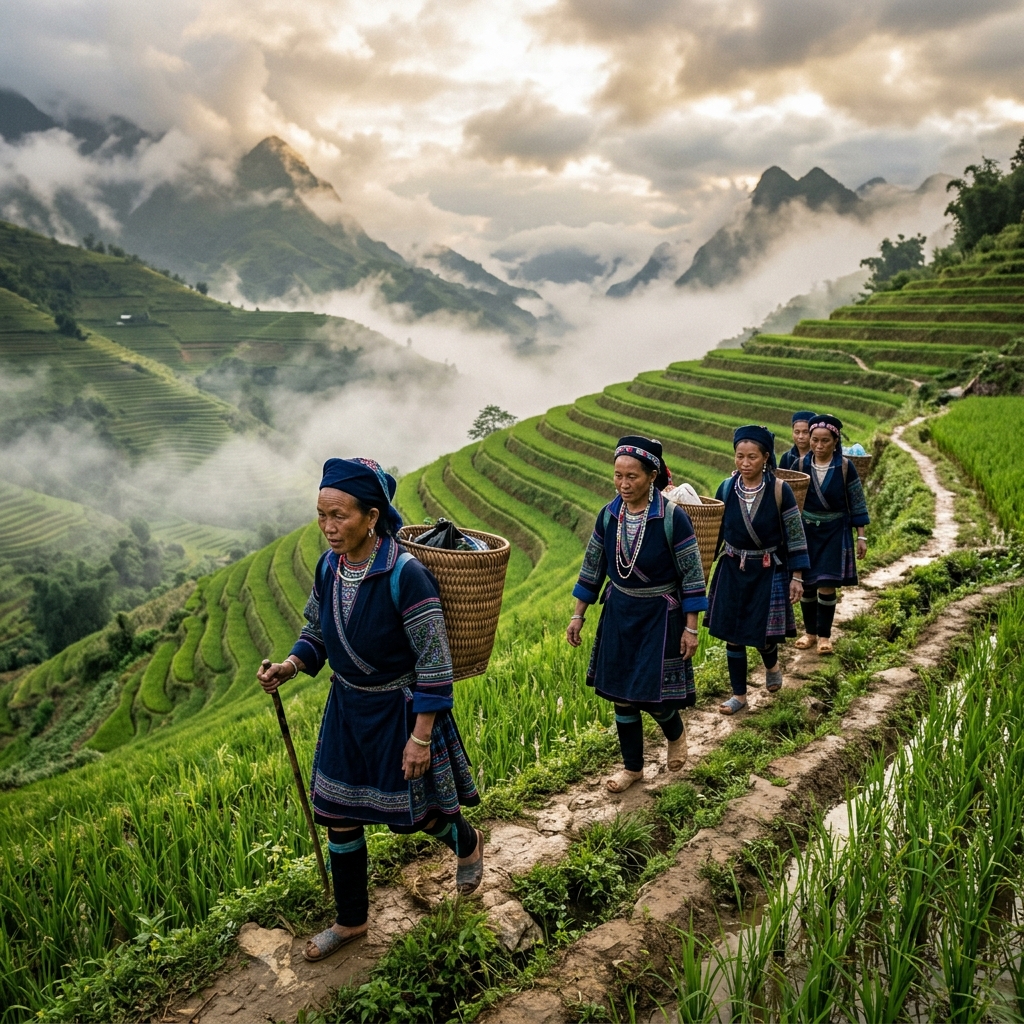
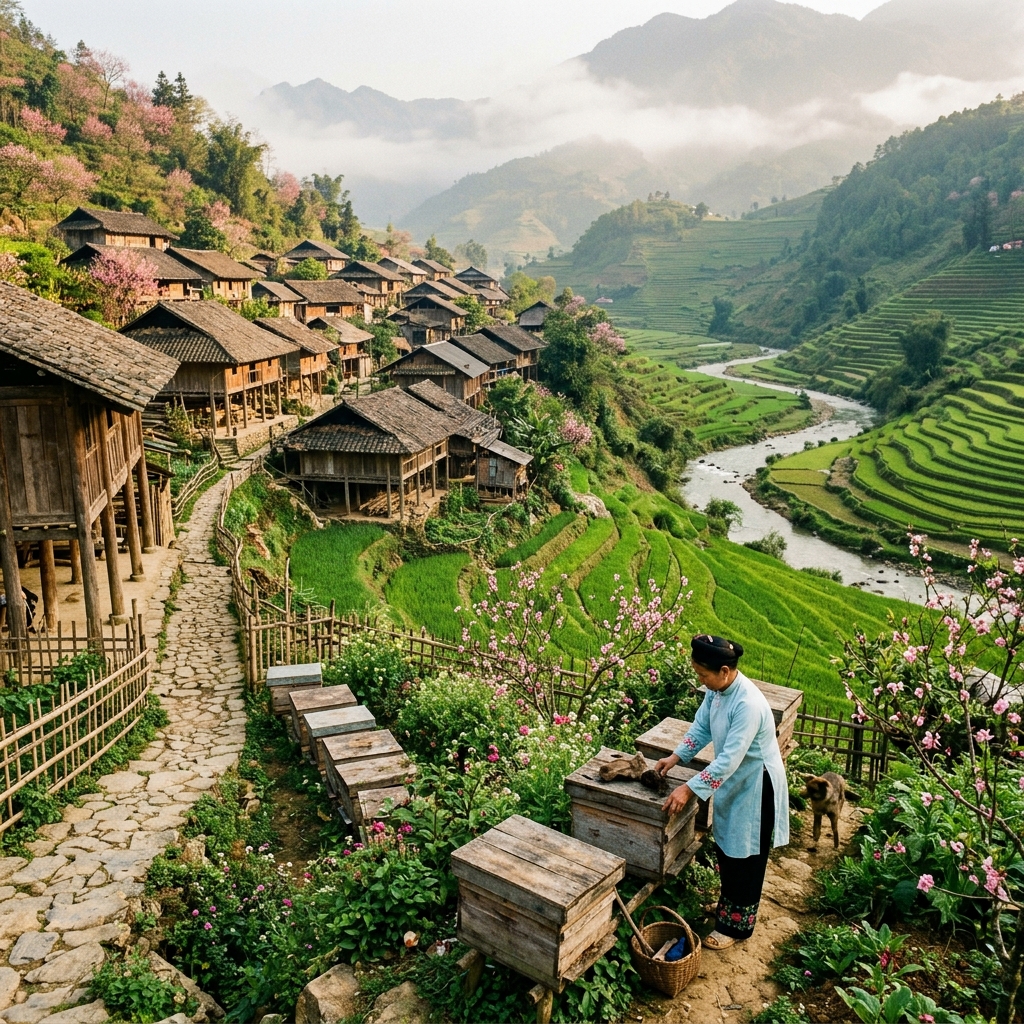
In Sapa, the Giáy settled in the Muong Hoa valley, particularly at Tả Van village — a confluence site between the Muong Hoa river and several mountain torrents, where fertile alluvium allowed for productive rice cultivation. The village features a characteristic spatial layout: houses in an arc around rice fields, connected by stone paths along irrigation canals.
Their position in the valley floors placed them at the crossroads of trade routes connecting the highlands (Hmong, Dao) to the Kinh plains and Chinese markets. The Giáy thus developed a culture of exchange and mediation — often speaking several languages and serving as intermediaries in transactions between ethnic groups.
Unlike the Hmong and Dao, who often had conflictual relationships with successive administrations, the Giáy generally maintained more peaceful relations with ruling powers — a strategy that allowed them to preserve their land and cultural autonomy over centuries.
Like the Tày, the Giáy build stilt houses — a shared characteristic among Thai family groups. The Giáy house is generally smaller and more compact than the large Tày house, but organized by similar principles: ancestral altar at the center, separate bedrooms, kitchen at one end, and a veranda open to the landscape.
The Giáy specificity lies in the attention given to gardens surrounding the house. Each household has a carefully maintained vegetable garden — high-altitude vegetables, aromatic herbs, fruit trees — and space dedicated to beehives.
Giáy mountain honey is one of the best edible souvenirs from the Sapa region. Several families in Tả Van have developed production sold to Sapa shops and passing travelers.
Spring honey, from foraging plum and peach blossoms, is particularly prized for its delicate floral notes.
Far from the deep indigos of Black Hmong and bright reds of Red Dao, the Giáy favor pastel tones and more nuanced chromatic combinations — a unique aesthetic in the region.
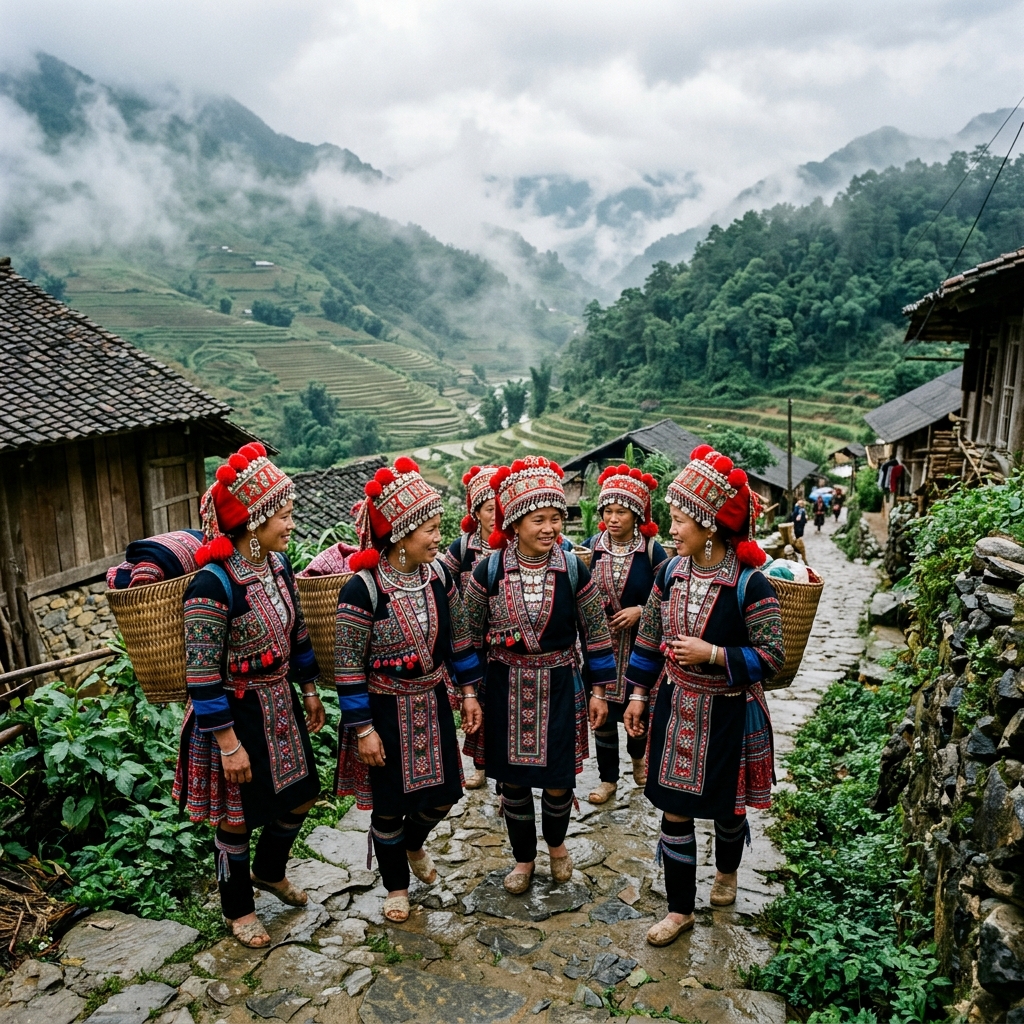
The female attire includes a slightly fitted high-collared tunic, buttoned on the side, in tones of sky blue, almond green, pale pink, or off-white. Embroidered strips adorn cuffs, neckline, and hem — delicate floral embroideries representing peach blossoms, butterflies, or birds in bright silk threads that contrast with the background sobriety.
The Giáy headdress is a remarkable piece: a flat plaited bamboo hat, covered with embroidered fabric or a colorful scarf, worn slightly tilted. In some sub-groups, silver ornaments or glass beads decorate the headdress on grand occasions.
Plaited weaving is the most characteristic Giáy craft. Tightly woven bamboo baskets, decorated rice baskets, light back hottes, hats, and trays — all with geometric patterns in dyed rattan (ochre, burgundy, black). Some baskets represent several weeks of work and are passed down as heirlooms.
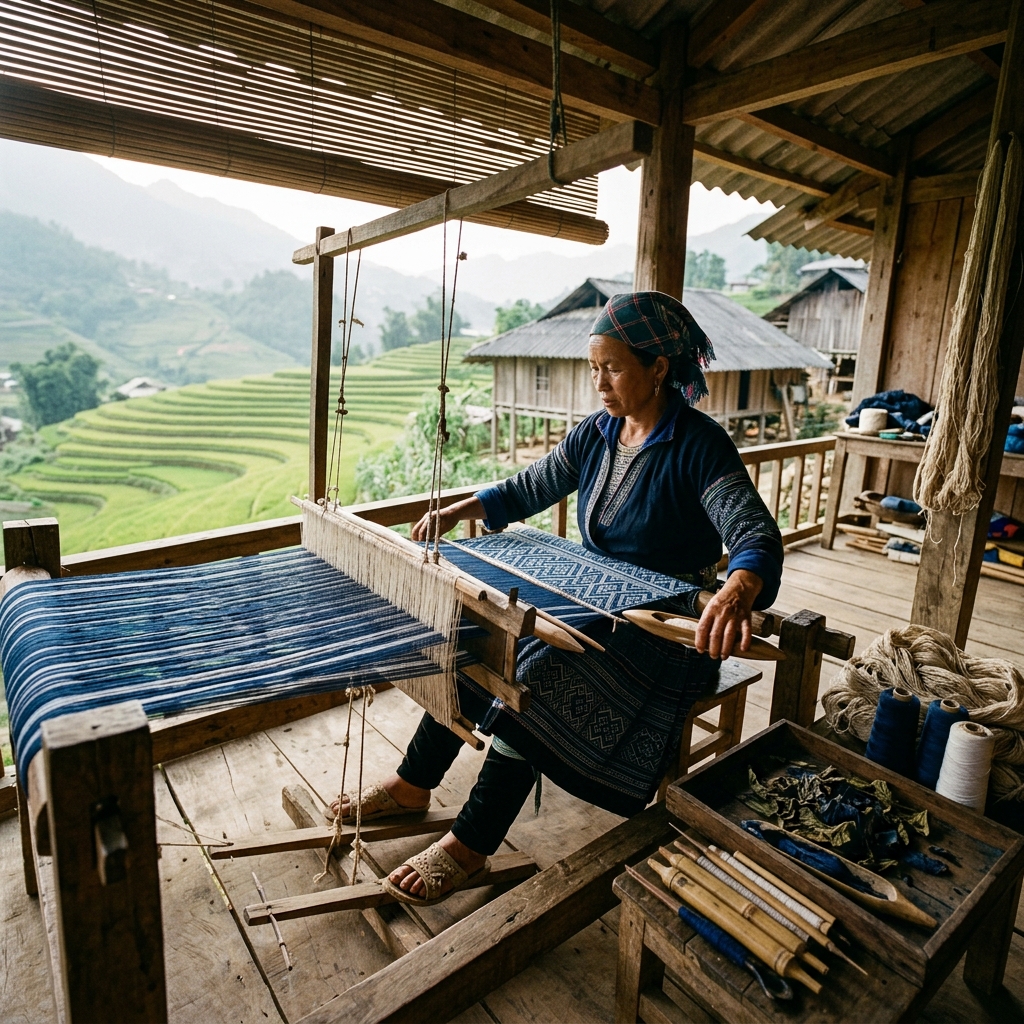
Silkworm rearing and silk weaving are Giáy specialities in certain valleys. Giáy silks, woven on traditional hand-looms, have a particular softness and luster — very different from industrial silks found in Sapa shops.
Giáy spirituality is a gentle and pragmatic animism, less codified than that of the Dao and less shamanic than that of the Hmong. It rests on the fundamental conviction that the visible world is inhabited by spirits — nature spirits, ancestors, protective genies of places — with whom a relationship of balance and respect must be maintained.
Center of family spiritual life, it receives daily incense, water, and food offerings. On major occasions, more elaborate ceremonies are led by the family head or a village ritual officiant.
The most important collective festival in the Giáy calendar, held at the start of the lunar year in Tả Van Giáy. Offerings to earth and water spirits, then collective games — archery, wrestling, ball games — and traditional dances. A rare occasion to see the community in full costume.
The Giáy practice geomancy to choose house locations, marriage dates, and sowing times — reading signs in terrain configuration, water stream orientation, and the lunar calendar. A practice revealing Chinese traditional influence on Giáy culture.
Plant medicine is less institutionalized among the Giáy than the Dao, but equally present. Each family maintains empirical knowledge of local plants — digestive tea, root for fever, leaves for treating wounds. Practical knowledge passed orally within the family unit, without the ritual and textual dimension characterizing Dao medicine.
Giáy society is patrilineal and organized around the family clan. Common clans in Sapa include Tẩn, Vàng, Sùng, and Lý. The Giáy family is renowned for its cohesion and sense of hospitality — receiving a stranger, feeding them, offering tea, and suggesting a place to sleep is a moral obligation deeply rooted in the culture.
This hospitality is not calculated or commercialized: it responds to a social reciprocity concept where human relationships are woven through exchange and giving. Being well-received in a Giáy house is being treated as a temporary family member.
Declining tea or food offered may be seen as disrespectful — accept with gratitude, even if you've already eaten.
The Giáy of Tả Van valley have experienced Sapa's tourism development differently from the Hmong of Lao Chải or the Dao of Tả Phìn. Their village, though on the most popular trek route in the region, has better preserved its residential and agricultural character — stilt houses coexist with rice fields without being massively converted into souvenir shops or guesthouses.
The Giáy, fewer and less mediatized than the Hmong, have attracted less direct tourist pressure. Their economy, based on a combination of agriculture, beekeeping, and small tourist services, is less mono-cultural than some Hmong villages entirely turned toward craft sales.
Several Tả Van families have developed mountain honey production sold to Sapa shops and passing travelers — an economic outlet valuing traditional expertise without requiring cultural rupture. It's one of the few regional examples where tourism generates extra income without denaturing the main activity.
The Giáy language — close to Tày and Thai — is still spoken by all generations in villages. Its transmission to children seems more solid than other groups, perhaps because the Giáy community, smaller and more geographically concentrated, has maintained sufficient social density for the language to remain the norm in daily interactions.
The Giáy number around 60,000 people in Vietnam according to the 2019 census, making them a relatively small ethnic group. They are concentrated in Lào Cai, Hà Giang, and Lai Châu provinces. In Sapa, the Giáy community of Tả Van is one of the most accessible and best preserved.
Giáy and Tày belong to the same large Thai linguistic family and share many cultural traits — stilt houses, irrigated rice cultivation, clan organization, animist spirituality. The Giáy are distinguished by their more colorful and pastel costumes, their craft specialities (fine basketry, beekeeping), and certain unique ritual practices like Roong Pooc. The two groups often cohabit in the same villages without major friction.
Yes — several Tả Van families sell their honey directly in the village or through intermediaries in Sapa. It is one of the best edible souvenirs in the region, produced from high-altitude wild flora. Spring honey, from foraging plum and peach blossoms, is particularly prized for its delicate floral notes.
Absolutely. Tả Van is often passed through quickly by trekkers reaching Sapa from Lao Chải. But the village deserves a stay — its alleys between stilt houses, irrigation canals lined with ferns, neat gardens, and warm inhabitants make it a destination in itself. Spending a night in a homestay is one of the most authentic experiences in the Sapa region.
No, unlike the Dao who developed Nôm Dao. Giáy culture is essentially oral — epics, wedding songs, tales, and knowledge passed by word of mouth. This oral tradition is rich and lively, but fragile against schooling in Vietnamese and digital media competition. Its preservation depends on community practice vitality.
We organize homestay stays with Giáy families in Muong Hoa valley — with bamboo weaving initiation, mountain honey tasting, and walks along rice fields — integrated into our custom tours.