Iconic Ethnic Group
The Hmong of Sapa
Indigo, batik, and rice terraces — the people who shaped the human face of North Vietnam's mountains.
Indigo, batik, and rice terraces — the people who shaped the human face of North Vietnam's mountains.
Among all the ethnic minorities in northern Vietnam, the Hmong are undoubtedly the most visible and iconic. Their indigo silhouettes in the alleys of Sapa, their embroidered headdresses in Bac Ha markets, their terraced rice fields carved into the mountainsides — the Hmong have become the human face of the region.
But behind this image lies a long and complex history, a culture of exceptional richness, and a people navigating today between millenary tradition and the contemporary world.
The Hmong are one of the oldest ethnic groups in Asia. Their origins trace back to the plains of Central China, in the Yellow River region. Gradually pushed south by successive expansions of Chinese empires, they settled in the mountain massifs of Yunnan, Guizhou, and Sichuan.
The Hmong primarily arrived between the 17th and 19th centuries, settling in the northern highlands — Lào Cai, Hà Giang, Lai Châu, Yên Bái — where high-altitude lands, little coveted by the Kinh (lowland Vietnamese), allowed them to perpetuate their agricultural and pastoral lifestyle.
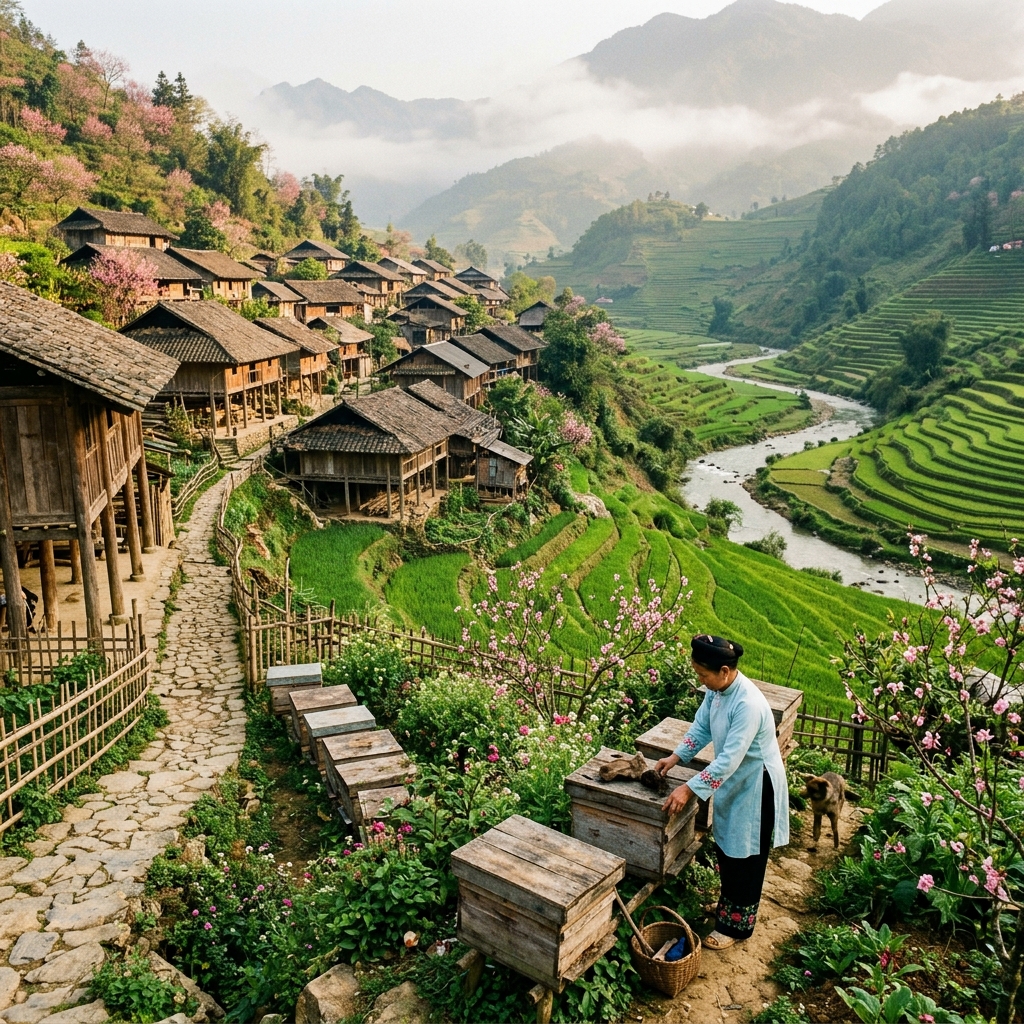
The Sapa region became one of their primary territories, with villages established between 1,000 and 1,800 meters altitude. This history of forced migrations forged a particular identity: a deep attachment to autonomy and a remarkable ability to preserve their culture in often hostile contexts.
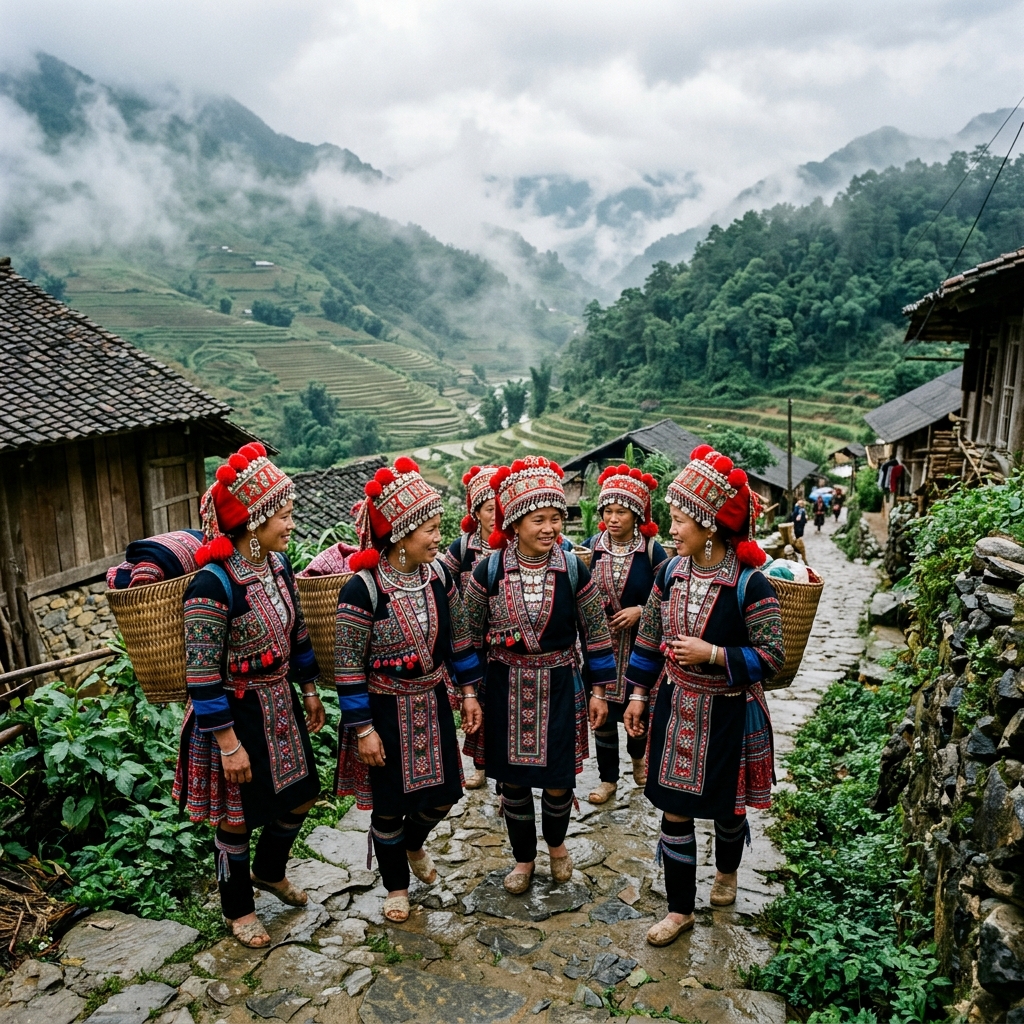
The Hmong do not form a uniform group. Several sub-groups are distinguished, primarily identifiable by the color and style of their traditional costume.
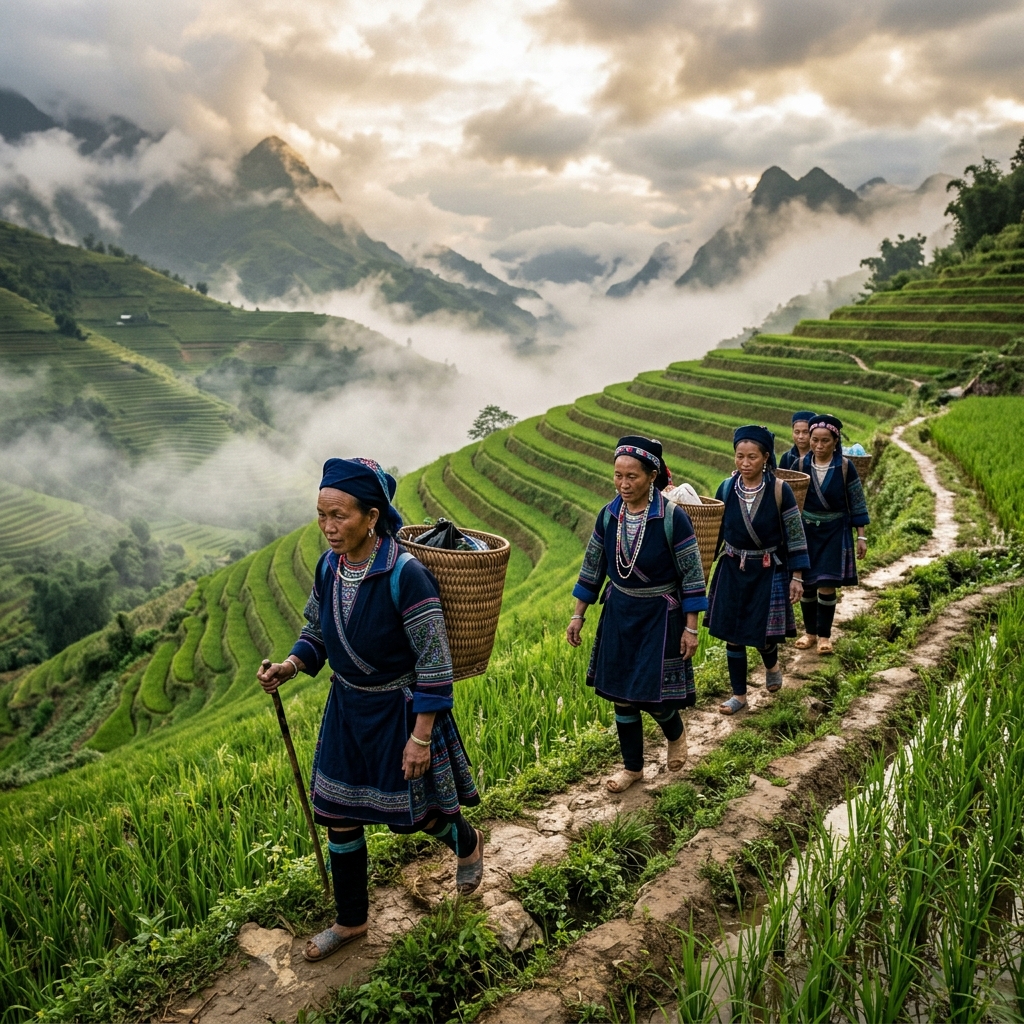
The most numerous around Sapa. Their name comes from their characteristic attire: tunic, trousers, and turban dyed in indigo to deep midnight blue tones. These are the ones most often encountered in the streets of Sapa and in the Muong Hoa valley.
Recognizable by their explosive color costumes — reds, greens, yellows, blues — covered with complex geometric embroideries. They are mainly found in the Bac Ha and Can Cau region, where their presence in Sunday markets is one of the most striking spectacles of northern Vietnam.
Wear soberer clothing, dominated by white and pale blue. Mainly settled in Sơn La and Lai Châu provinces, they are less represented around Sapa.
Other sub-groups present in the region, with their own costume and dialect variations. Despite these differences, all share a common language (Hmong, Sino-Tibetan family), similar social structures, and a common cultural and spiritual foundation.
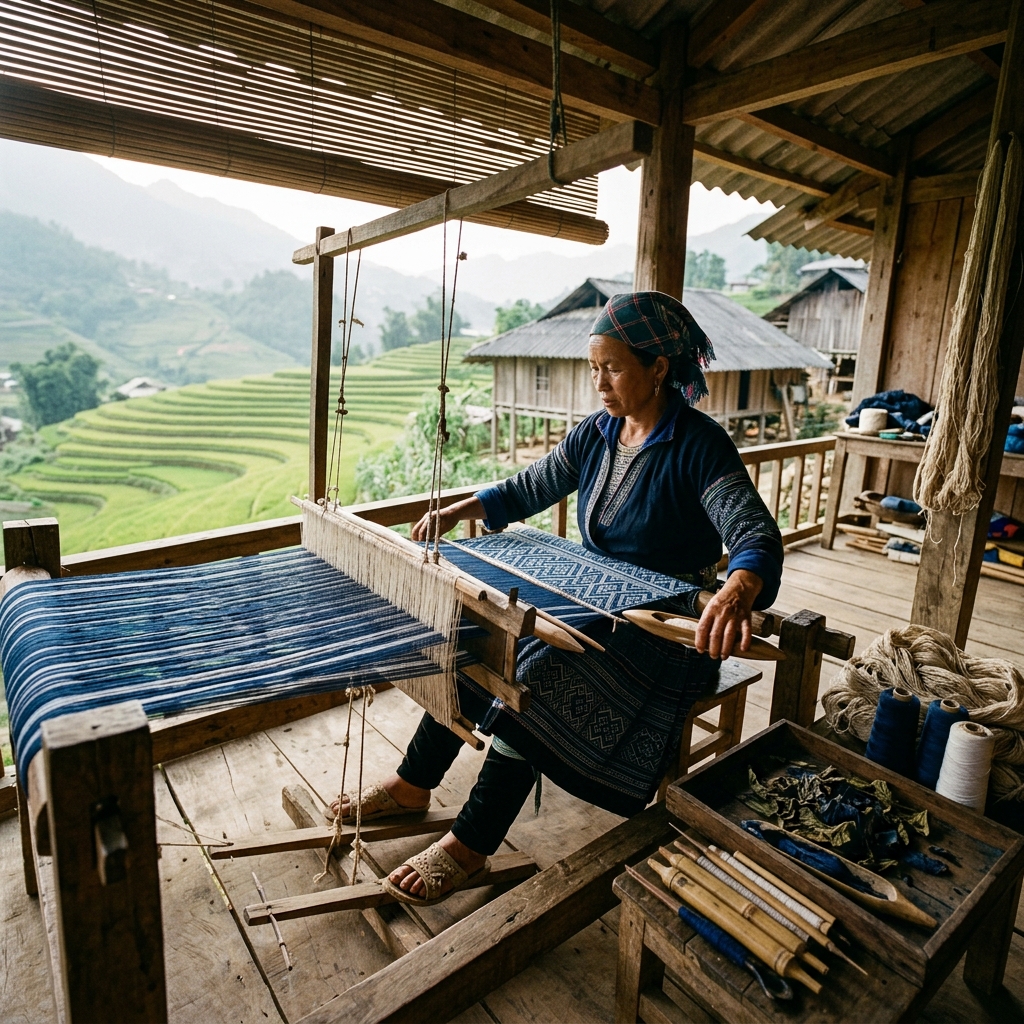
For the Hmong, clothing is not just a garment — it's a marker of identity, a family narrative, and a work of art. Making a complete costume represents several months of work, from hemp cultivation to the final embroidery.
Making a complete Hmong costume requires several months of work:
— Spring: Hemp planting and harvesting
— Summer: Spinning, weaving, and first indigo baths
— Autumn: Wax batik application
— Winter: Final embroideries
A costume can require up to 200 hours of 100% manual work.
Hmong society is organized around the patrilineal clan (xeem in Hmong). There are about a hundred distinct clans — Lo, Vang, Yang, Thao, Her, Moua among the most common. Clan membership structures all social life: members of the same clan share common rituals, help each other in times of difficulty, and cannot marry each other.
The extended family is the basic unit. Several generations often live under the same roof or in neighboring houses. The authority of the father and elders is central, although women play a crucial economic and cultural role — they are the ones who weave, embroider, raise children, and manage a large part of the domestic economy.
Marriage is a major social act, often arranged between families, with a dowry system paid by the groom's family. The traditional practice of "bride kidnapping" (zij poj niam) has been the subject of significant controversy in recent years, especially when it exceeds the ritual consent framework.
Hmong spirituality is a complex animism in which the visible world and the world of spirits (dab) are intimately linked. Each place — forest, river, mountain, house — is inhabited by spirits that can be benevolent or malevolent.
A central spiritual figure, they serve as intermediaries between the living and the spirits, diagnose illnesses caused by a wandering soul, and preside over funeral ceremonies. Their vocation is imposed upon them after an initiatory crisis experienced as a serious illness.
The family altar, on the main wall of the house, receives regular offerings — incense, rice, alcohol. Major festivals — New Year (Nào Pê Chầu), Gầu Tào festival — are occasions for collective ritual and cultural transmission.
The Hmong community in the Sapa region is currently at the intersection of several contradictory dynamics.
Tourism has profoundly transformed the life of the Black Hmong since the 1990s. Many women have learned French, English, or Mandarin to sell their crafts. This openness has brought new income but has also accelerated certain mutations — standardization of embroidery for the tourist market, gradual abandonment of traditional costume in daily life, especially among young men.
State-mandated schooling in Vietnamese has allowed a generation of young Hmong to access new economic opportunities. But it has also created a linguistic and cultural gap with older generations.
The land issue is a source of significant tension. Tourism development pressure encroaches on Hmong agricultural lands and ritual sites, raising questions of land access and minority rights rarely decided in their favor.
Associations of women artisans work to promote authentic crafts. Young Hmong use social media to document and broadcast their culture. And in the remote villages of the valley, women still embroider, shamans still officiate, and children still learn their mother tongue before Vietnamese.
The Hmong are the 8th largest ethnic group in Vietnam with about 1.4 million people according to the 2019 census, concentrated in northern mountainous provinces. Globally, the Hmong population is estimated at over 4 million people, spread across Vietnam, Laos, China, Thailand, and the Western diaspora (USA, France, Australia).
The Hmong language is traditionally oral. Several writing systems were developed in the 20th century, including the Pahawh Hmong alphabet (created in 1959 by a Laotian peasant) and the RPA romanization developed by American missionaries. None are universally adopted, and cultural transmission remains mostly oral.
Yes, especially in the villages of Lao Chải and Tả Van in the Muong Hoa valley. Conditions are simple but the welcome is warm. Hmong families offer homestays organized through Sapa agencies or directly. It's one of the best ways to understand the community's daily life.
The commercial pressure that some travelers perceive comes from a difficult economic reality. Income from crafts and informal guiding is often the only source of monetary income for families whose subsistence agriculture is no longer sufficient. Buying directly from artisans at a fair price is the best response to this situation.
In villages, yes — Hmong remains the language of the home and community relations. But Vietnamese schooling and exposure to media and smartphones accelerate the decline of Hmong as a prestige language among young urban generations. This is one of the major concerns for Hmong cultural activists in Vietnam and the diaspora.
We organize authentic Hmong village visits, batik and indigo workshops, and dinners with locals in the Muong Hoa valley — integrated into our custom tours.