Living Craftsmanship
Traditional Weaving in Sapa
Hand-spun hemp, silk from silkworms, machine-free jacquard — the mountain minority textile, a millenary language still alive in the region's villages.
Hand-spun hemp, silk from silkworms, machine-free jacquard — the mountain minority textile, a millenary language still alive in the region's villages.
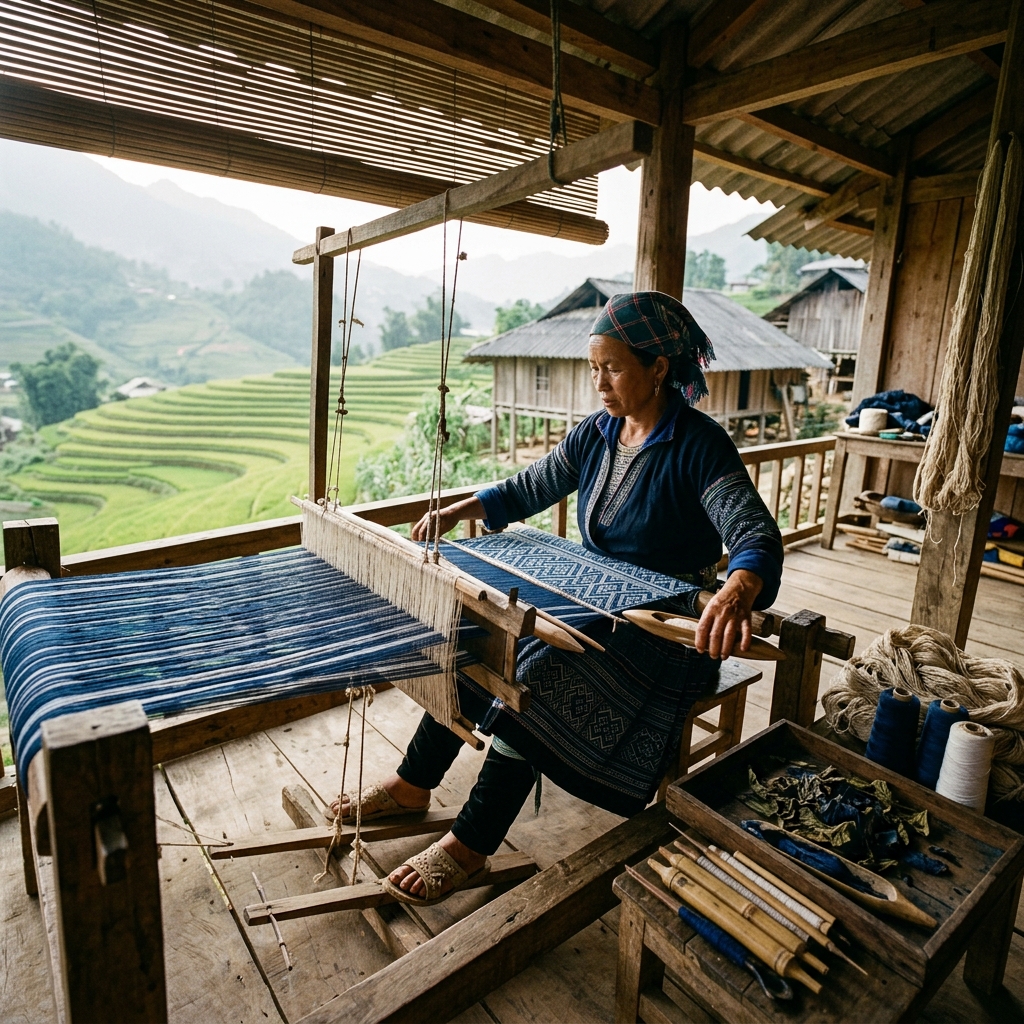
There is something almost hypnotic about watching a Hmong woman at her loom. Hands passing the shuttle, feet operating the pedals, the beater packing the threads — a steady, almost meditative rhythm that can last for hours without interruption.
In Sapa and surrounding villages, weaving is not a folkloric curiosity. It is a daily practice, a skill passed from mother to daughter for generations, and one of the deepest expressions of mountain ethnic identity.
In North Vietnam's ethnic minority cultures, textile is a language. A garment doesn't just say who you are — it tells where you come from, which clan you belong to, your marital status, and sometimes even which spirits protect you.
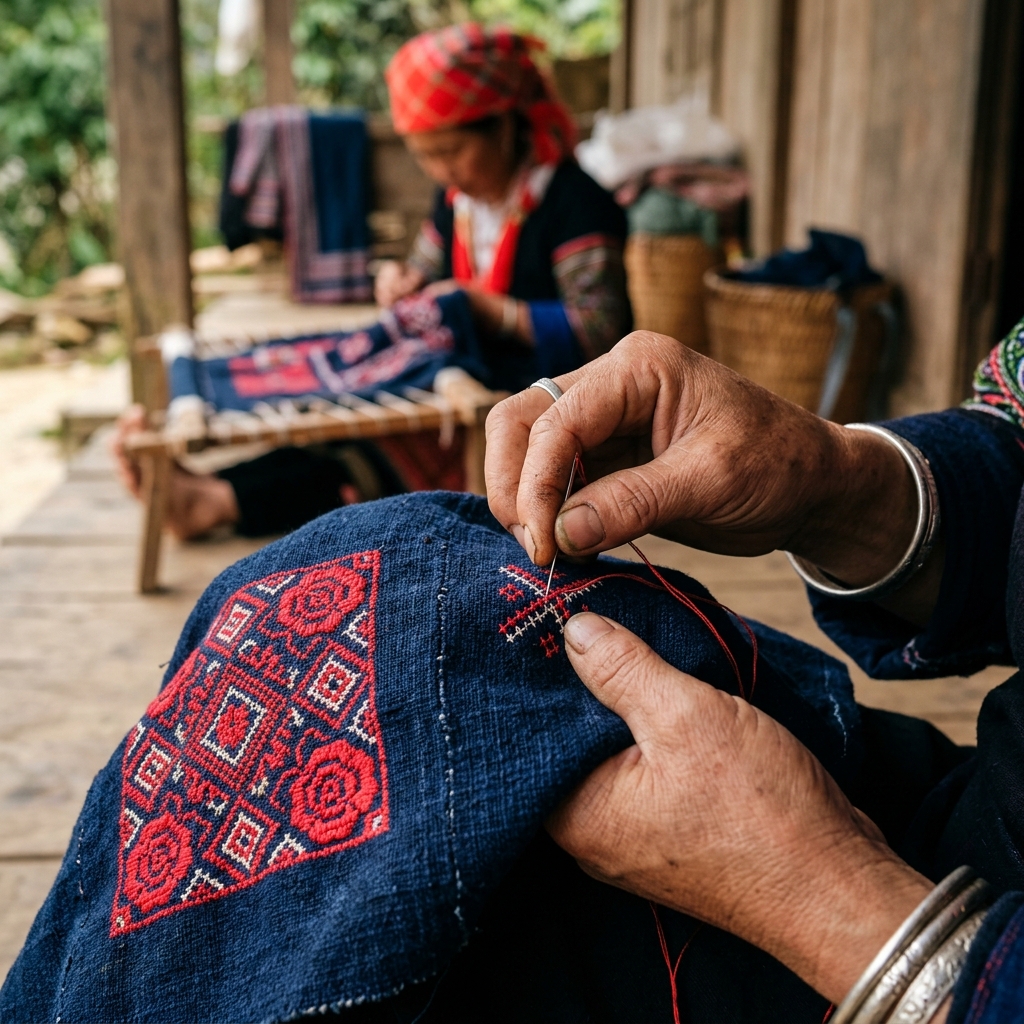
Learning to weave is not just acquiring a manual skill: it's entering a system of meaning, symbols, and collective memory. For the Tày, Giáy, Hmong, and Xa Phó, home-made fabric is the raw material for everything — clothes, blankets, bags, belts, ritual ornaments.
Before industrial fabrics reached mountain markets, each family produced all its textile needs. This autonomy required complete mastery:
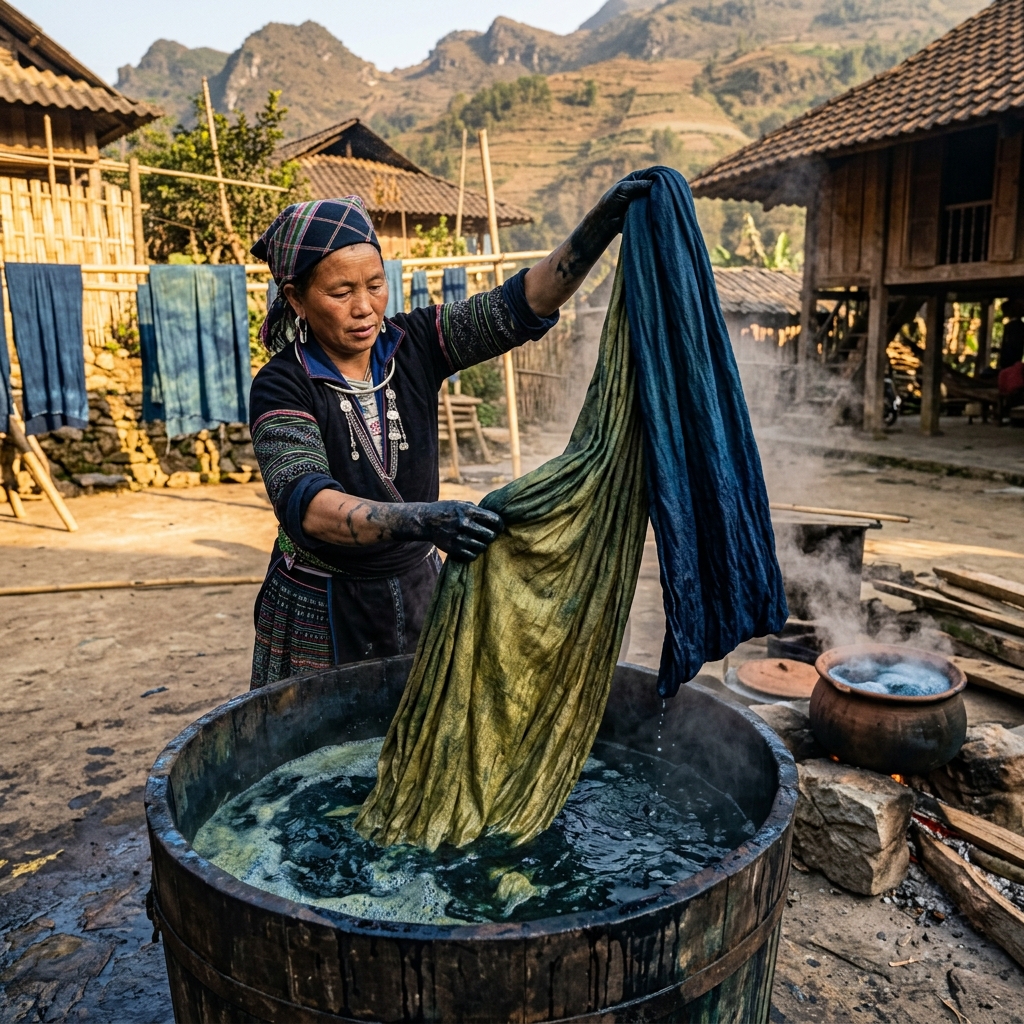
Each ethnic group has its preferred raw materials, determined by tradition, altitude, and available resources.
A robust plant growing well at altitude, sown every spring in village gardens. Stalks are harvested in autumn, retted in water to soften fibers, then hand-split into filaments. These are spun on a manual spindle to obtain a regular, resistant thread. The best spinners produce thread capable of rivaling industrial linen.
Sericulture (Bombyx mori) is a demanding activity — worms must be fed fresh mulberry leaves several times daily for 4-5 weeks before spinning cocoons. Reeling cocoons in hot water produces a continuous thread up to 1,500 meters — with a softness and luster no synthetic fiber faithfully reproduces.
Used by several groups as a complementary fiber, often mixed with hemp or silk to modify the final fabric's texture or dyeing behavior. The Dao traditionally grew cotton in their mountain gardens — a practice less common today but being rediscovered in some villages.
In the Sapa region, one finds several loom types, each associated with an ethnic group and specific fabric type.
Installed under a veranda or house, operated simultaneously by hands (shuttle) and feet (pedals lifting shafts alternately). This loom produces plain fabrics, stripes, and simple patterns at high speed. An experienced weaver can produce several meters of fabric daily.
Extra shafts, operated by hand-manipulated cords during weaving, allow lifting certain warp threads independently to create geometric relief patterns directly in the fabric structure — without added embroidery. An experienced Tày weaver carries dozens of patterns in memory, reproducing them without written guides. A pace of 30-50 cm daily for complex motifs.
Fixed to a post or tree on one side and the weaver's waist on the other; she adjusts tension by leaning back. Simple and portable, it produces narrow bands (belts, straps, ornaments) of remarkable density and regularity — and can be set up anywhere, even in a field.
Silk weaving among the Sapa Tày deserves special attention. This tradition, which declined significantly from the 1970s–90s due to agricultural collectivization and cheap synthetic textiles, has seen significant interest regain since the 2010s.
Several Tày families in Bản Hồ and Nam Sài have relaunched silkworm rearing and traditional weaving, encouraged by development associations and growing demand for authentic crafts from travelers and Vietnamese design shops.
Current Tày silk products — scarves, fabric by the meter, decorative pieces — are sold at prices finally reflecting the real value of the work they represent.
This renaissance illustrates a broader dynamic: the economic valuation of authentic craftsmanship as an alternative to mass tourism and a way to preserve disappearing skills.
Buying a Tày silk scarf from Bản Hồ directly contributes to the economic survival of this artisanal revival.
The best place in the region to observe Tày weaving in real conditions. Women work under verandas or houses, often in groups. A slow, respectful visit allows witnessing all stages — from reeling cocoons to finished fabric.
In the Muong Hoa valley, to observe Hmong weaving: hand-spun hemp, hand loom, and thread preparation stages. Several village houses allow observation, especially outside peak tourist season.
The most direct place to buy. Tày and Hmong women sell hand-woven pieces here — blankets, scarves, fabric by the meter. Golden rule: favor stands held by producers who can explain their work over resellers.
These cooperatives offer fabrics selected directly from artisans with origin and production condition guarantees. Slightly pricier than the market, but the purchase has a measurable direct impact on producing communities.
Offered by several Sapa structures — a half-day on a hand loom is enough to concretely understand the difficulty and precision required. Often one of the most memorable activities of a Sapa stay.
A legitimate question in Sapa markets where industrial products imitating traditional crafts abound. Here are the signs:
Slight Irregularity in Thread Density — Imperceptible to the eye but sensible to touch. The fabric doesn't feel perfectly uniform, which is what makes it beautiful.
Slightly Wavy Selvedges — Fabric edges are irregular, unlike the perfectly straight edges of machine-cut industrial fabric.
Greater Thickness and Weight than equivalent industrial fabric — Hmong hemp and Tày silk are substantial natural materials, not light imitations.
Patterns Visible on Reverse for Jacquard fabric — they are part of the structure, not a separate print or embroidery. Turn it over: the pattern should be readable on both sides.
Best Guarantee is Buying Directly from the Producer observed at work — in her village or at a market stand.
It depends on complexity. For plain hemp, an experienced woman can produce 2-3 meters a day. For complex Tày jacquard, the pace drops to 30-50 cm daily. A full blanket can represent one to two weeks of full-time work.
Yes. Several structures offer half or full-day workshops. You won't master it — that takes a childhood — but you'll understand basic gestures and take home a personal experience.
Yes, without hesitation. A hand-woven Tày blanket from Bản Hồ represents weeks of labor and quality fibers. It will last decades — families pass them down as heirlooms. Expect 500,000 to 1,500,000 VND for an authentic piece.
Traditionally yes, in all regional ethnic groups. Weaving is an exclusively female skill. Men handle other crafts — carpentry, blacksmithing, basketry — but never weaving in the strict sense.
For durable authenticity, favor:
We include workshop visits and loom initiations in our tours — in Tày villages like Bản Hồ or with Hmong artisans in Muong Hoa valley. A concrete, memorable experience beneficial to artisanal communities.