Forest People
The Xa Pho of Sapa
The least known, the best preserved — shamans with wooden swords, sacred forests, and millenary rituals in forgotten Hoàng Liên Sơn hamlets.
The least known, the best preserved — shamans with wooden swords, sacred forests, and millenary rituals in forgotten Hoàng Liên Sơn hamlets.
Of the five major ethnic groups in the Sapa region, the Xa Pho are undoubtedly the least known. No explosive costumes visible in city center streets, no massive presence in weekend markets, no easily accessible village from hotels.
The Xa Pho live in seclusion, in hamlets perched between 800 and 1,200 meters altitude, away from main tourist axes. It is precisely this discretion that makes their discovery so precious — and their culture, largely preserved from touristification, so authentic.
The Xa Pho — also spelled Xá Phó or called Phù Lá in some classifications — belong to the Tibeto-Burman linguistic family, fundamentally distinguishing them from their Hmong neighbors (Sino-Tibetan) and Tày-Giáy (Thai). This suggests different geographical origins — likely the Tibetan plateaus or Western Yunnan — and a distinct migratory history.
The Xa Pho have been in Sapa for centuries, but their precise history remains poorly documented — they have no written tradition and ethnographic research long neglected them for larger groups. Vietnamese Ethnology Institute studies portray a people of hunter-gatherers who gradually settled, developing mountain agriculture while maintaining deep forest links.
Unlike the Hmong and Dao, who have large populations in several Southeast Asian countries, the Xa Pho are almost exclusively in Vietnam, mainly in Lào Cai and Yên Bái provinces. This narrow geography contributed to cultural cohesion but also vulnerability — a small group on limited territory is more sensitive to external pressures.
In Sapa, the Xa Pho mainly inhabit Nậm Cang, Nậm Sài, and several isolated hamlets on the eastern and southern slopes of the Hoàng Liên Sơn massif, areas few travelers reach without an experienced local guide.
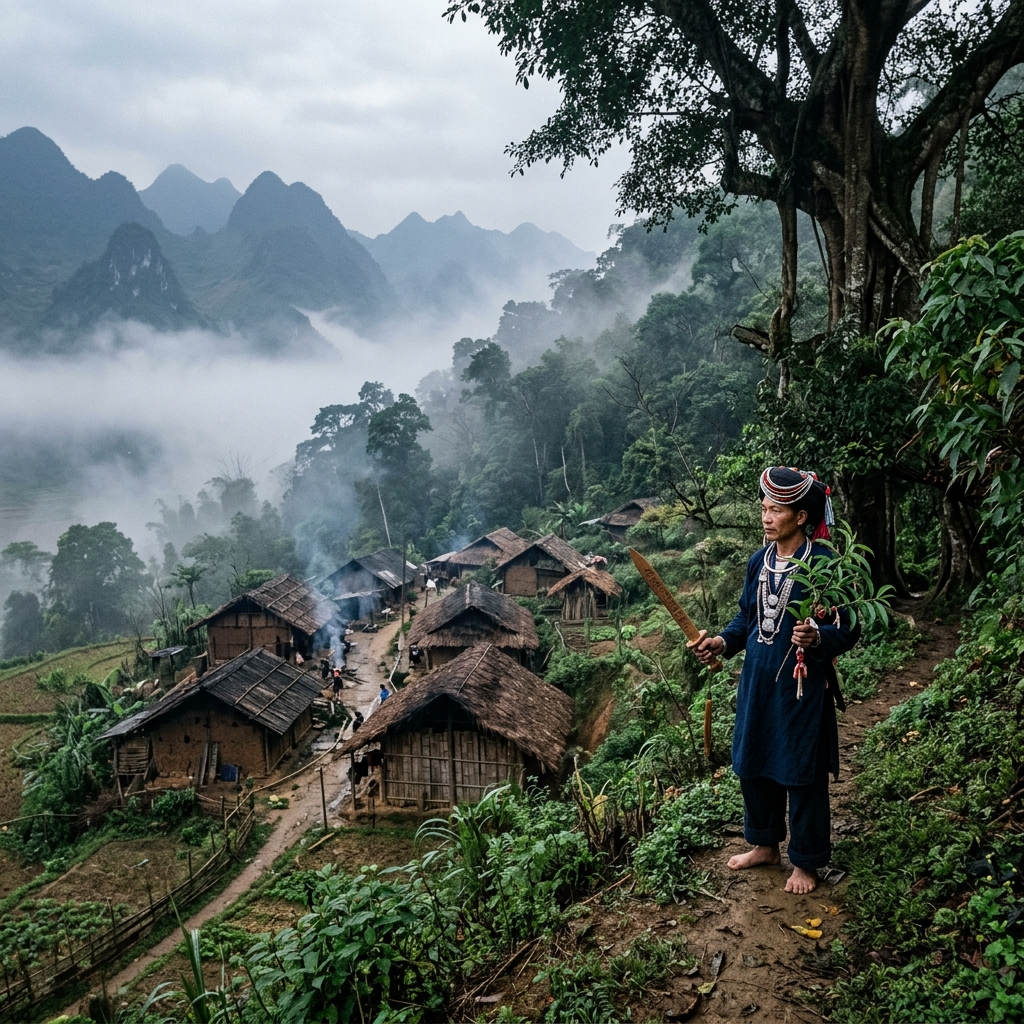
Traditional Xa Pho habitat differs from Tày and Giáy stilt houses. Xa Pho build on the ground — or slightly raised on small stone stilts — with wattle and daub walls (clay mixed with straw), plaited bamboo, or wood planks depending on local resources.
Space between houses is occupied by vegetable gardens, chicken coops, and pig pens — reflecting highly developed domestic self-sufficiency. Each Xa Pho family produces almost everything they consume, monetizing only a small part of their resources.
This economic autonomy is why Xa Pho have kept their culture relatively preserved despite rapid regional changes.
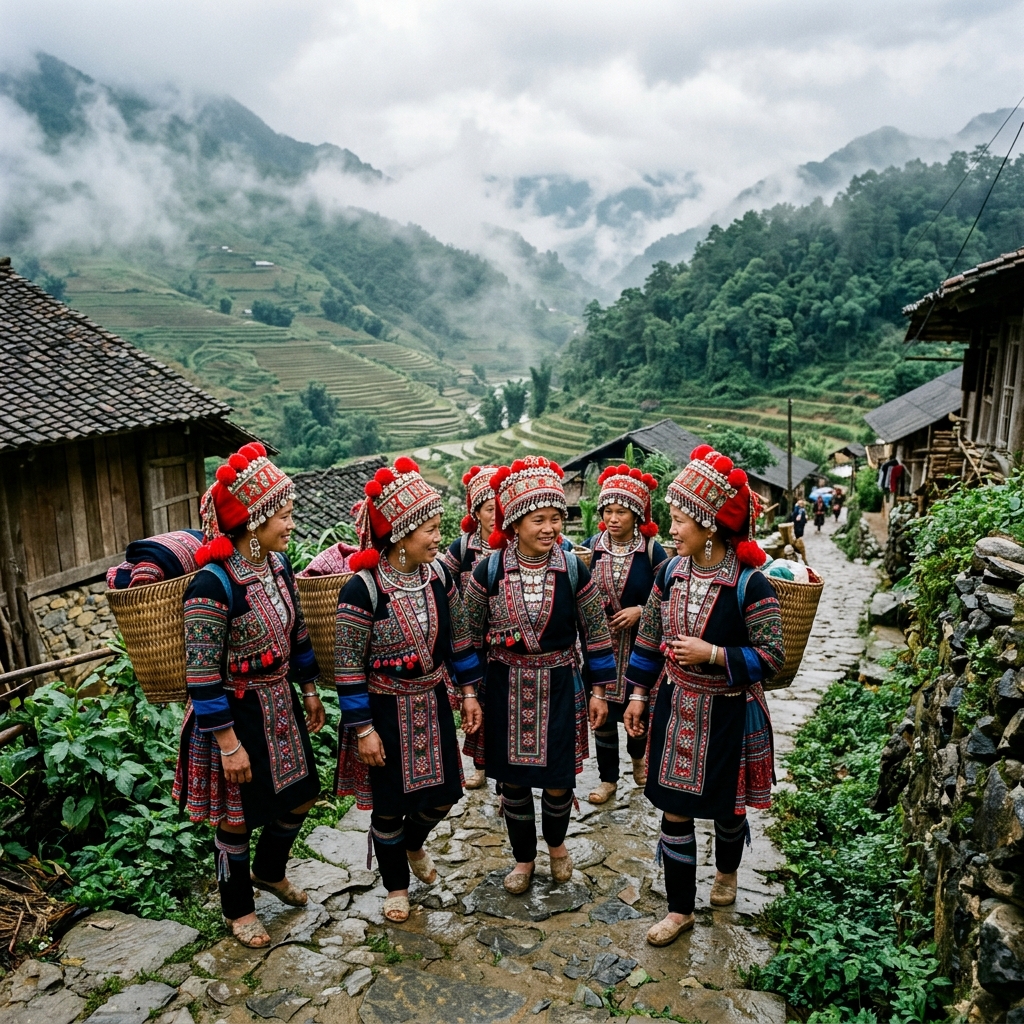
The Xa Pho costume is among the region's most understated and elegant. It relies on a narrow color palette — black, deep indigo, and white — and discreet yet precise ornamentation revealing strong cultural identity to the trained eye.
Cut slightly above the knees and worn over wide matching trousers. White fabric bands or fine embroidery adorn the collar, sleeves, and hems — precise and meaningful ornamentation.
A long dyed fabric scarf, tied at the waist with ritual precision. Different knots and tying methods have social meanings only Xa Pho women can read — invisible vestiary language to foreigners.
An indigo fabric turban wrapped characteristically, sometimes adorned with colorful wool pompons or braided silver threads. Each Xa Pho sub-group has its own way of tying it — an immediately readable community badge.
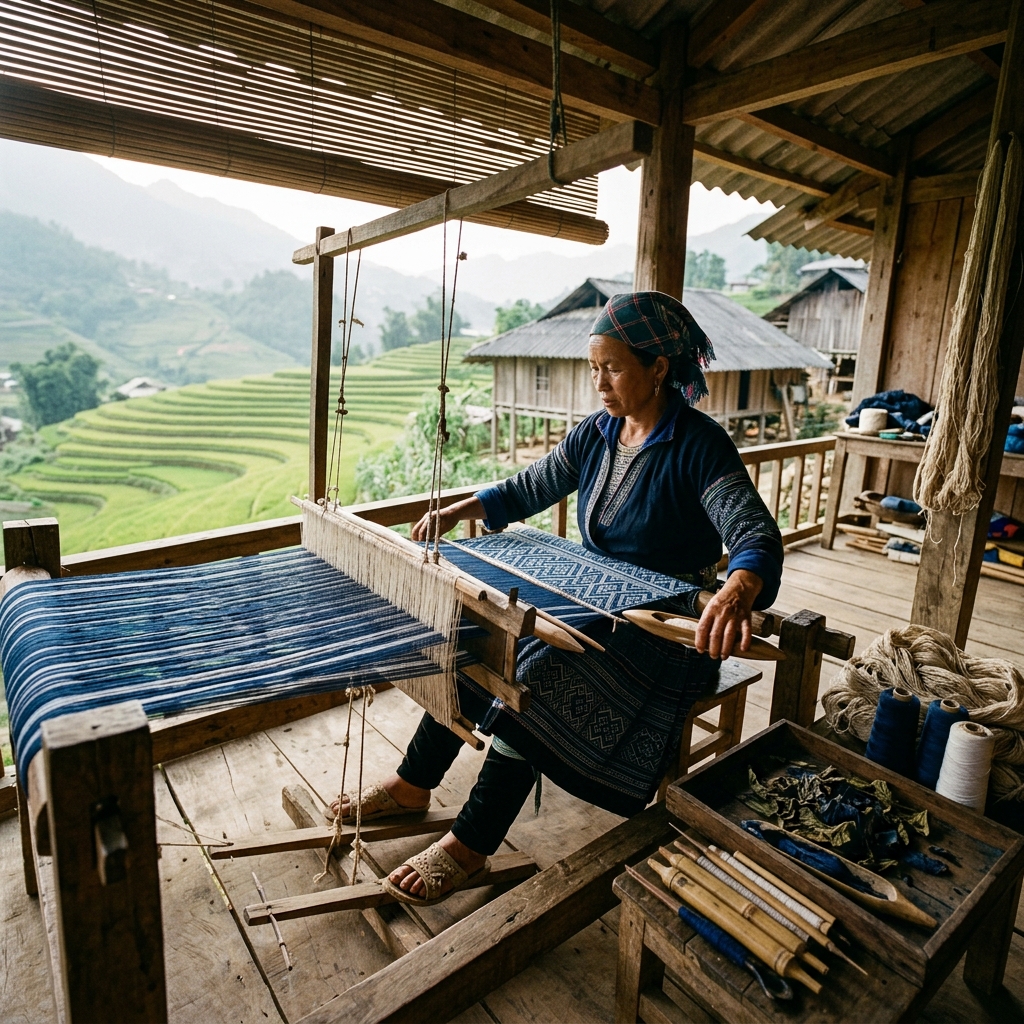
Like Black Hmong, Xa Pho women cultivate and process their own indigo, mastering fermentation and color fixation. Embroidery, less abundant than neighbors', focuses on collar, cuffs, and trouser bottoms — fine angular geometric motifs and stylized animals.
Xa Pho spirituality is among the region's richest and best preserved — precisely because village geographical isolation protected ritual practices from modernizing pressure longer than groups more exposed to tourism.
Always a man, chosen by spirits after an initiatory crisis. He diagnoses spiritual illnesses, leads village protection rituals, and guides deceased souls. His practice uses drums, rattles, special costumes — and epic chants in Xa Pho language lasting hours.
The most spectacular collective ceremony: shamans with soot-blackened faces, in ritual costumes, holding wooden swords and peach leaf branches, roam each hamlet performing exorcism dances. Held on Ngọ and Mùi days of the second lunar month — visually striking.
In September or October, women in full costume set out at dawn to cut the first ripe rice stalks — in silence, crossing no one. This rice is offered to ancestors before harvest starts. A rare poetic ritual, charged with ancestral agricultural conception.
Belief in forest spirits is very lively among Xa Pho. Every old tree, rock, and spring has its own spirit. Offerings are made before entering certain forest areas, before cutting large trees, or hunting.
This respectful nature relationship has concrete implications: Xa Pho long maintained untouchable sacred forest zones, seasonal hunting bans, and gathering rules — an ancestral form of sustainable ecosystem management:
Xa Pho society is patrilineal, organized around clans sharing a common male ancestor and ritual obligations. Common clans include Lý, Sần, and Phù.
Vietnamese Ethnology Institute researchers are working to document Xa Pho language, ritual chants, and botanical knowledge — a race against time.
The community is becoming aware of its cultural heritage value, organizing traditional festivals and encouraging costume wearing on major occasions.
The Xa Pho are among Vietnam's most vulnerable ethnic groups — not due to conflict, but because of small numbers and constant cultural assimilation pressure.
With fewer than 10,000 Xa Pho total in Vietnam, the critical mass for autonomous cultural reproduction is fragile. Schooling in Vietnamese, TV, smartphones, and intermarriage create assimilation pressure. The Xa Pho language is now considered vulnerable by linguists.
Tourism in Nậm Cang and Nậm Sài is starting as trekking and homestays. This is double-edged: it brings income and external valuation, but can accelerate changes — uniformizing practices or abandoning complex rituals.
Never visit a Xa Pho village without a trusted local guide and prior notice. Discretion, respecting ritual spaces, and no cameras during ceremonies are minimal conditions.
Around 8,000 to 10,000 people — one of the country's smallest groups, almost exclusively in Lào Cai and Yên Bái.
The costume — understated indigo tunic, characteristic turban, discreet collar/cuff embroidery — is less immediately spectacular. They are rarely in Sapa center; best met in their villages or local markets.
Yes, but it requires specific organization. Nậm Cang and Nậm Sài are reachable by motorbike or car. A local guide is indispensable for respectful contact.
It's a community ceremony, not a tourist event. Some assist always introduced by trusted local guides and being discreet observers. Never go without invitation.
Small numbers, village distance from main axes, and a less "spectacular" costume than Hmong or Dao. This makes their discovery precious for curious travelers.
We organize 2-3 day immersive treks in Hoàng Liên Sơn Xa Pho villages — with experienced local guides, homestays, and authentic meetings off the beaten path. Custom-made, with total community respect.